

 English
 Deutsch
 Español
 Français

Engineering a More Stable Aluminum Folding Camping Table for Windy Outdoor Conditions
Content
- 1 1. The Role of a Folding Table in Modern Outdoor Activities
- 2 2. Product Overview and Main Design Advantages
- 3 3. Why Aluminum Alloy Is Suitable for Portable Outdoor Furniture
- 4 4. Frame Geometry and Stability Under Dynamic Wind Loads
- 5 5. Cross-Bracing and Torsional Rigidity
- 6 6. Comparative Structural Performance
- 7 7. Wind Testing and Engineering Verification
- 8 8. Precision Joints and Manufacturing Quality
- 9 9. Roll-Up Tabletop Design and User Convenience
- 10 10. Advantages Over Lower-Cost Competitors
- 11 11. Manufacturing and Supply-Chain Strengths
- 12 12. Practical Use in Different Outdoor Scenarios
- 13 13. Operation, Care, and Safety Recommendations
- 14 14. Frequently Asked Questions
- 14.1 Q1: Is the table suitable for strong wind?
- 14.2 Q2: What makes the aluminum alloy frame better than a steel frame?
- 14.3 Q3: Does a wider leg angle always make a table more stable?
- 14.4 Q4: Why is X-bracing useful?
- 14.5 Q5: Can an existing table be modified for better wind resistance?
- 14.6 Q6: Is the roll-up tabletop strong enough for cooking equipment?
- 14.7 Q7: How compact is the table when folded?
- 14.8 Q8: Can the product be customized for private-label sales?
- 14.9 Q9: How does the manufacturer control product consistency?
- 14.10 Q10: What should buyers consider when selecting a supplier?
- 15 15. Conclusion
- 16 References
- 17 Product: Outdoor aluminum alloy folding table, camping table, egg roll table
An outdoor table may appear to be a simple piece of camping furniture, but its performance depends on a combination of material science, structural geometry, manufacturing precision, and real-world testing. A table used at a campsite, beach, mountain trailhead, or outdoor event must support cookware, food, coolers, and equipment while remaining stable on uneven ground. It must also fold into a compact package, assemble without tools, resist corrosion, and survive repeated transportation and use.
The outdoor aluminum alloy folding table, camping table, and egg roll table described in this article is designed around these practical requirements. It combines a lightweight aerospace-grade aluminum alloy frame with a roll-up tabletop, folding structure, portable storage bag, and carefully considered support geometry. The result is a product suitable for camping, outdoor cooking, picnics, hiking basecamps, mountaineering support areas, and mobile outdoor dining.
Unlike low-cost folding tables that focus only on low weight or minimal production cost, this table is developed with a broader understanding of outdoor use. Its design considers lateral stability, torsional rigidity, wind exposure, corrosion, portability, joint durability, and the demands of repeated folding. These factors help distinguish a dependable camping table from a basic temporary surface.
1. The Role of a Folding Table in Modern Outdoor Activities
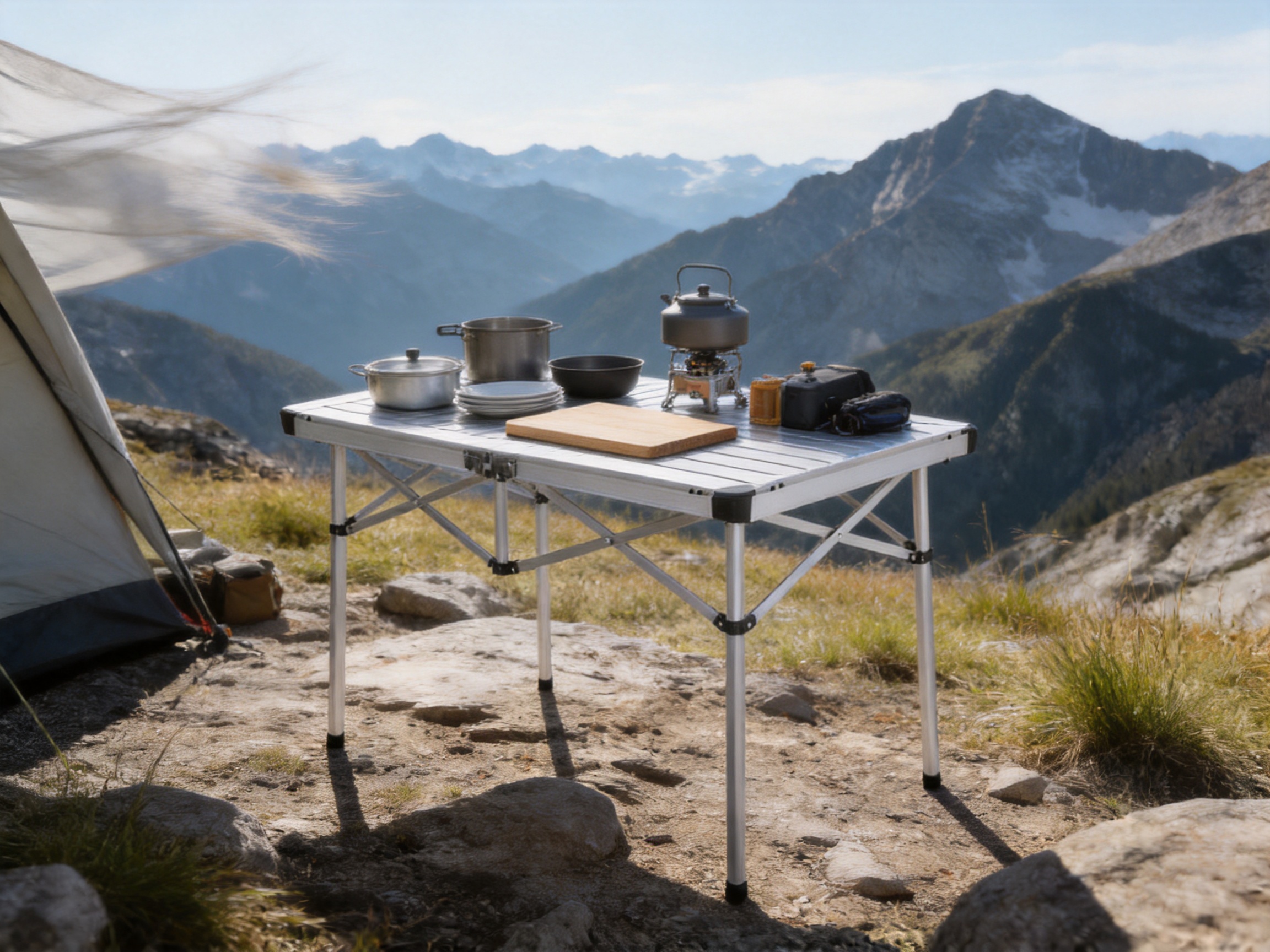
A camping table is often used as a central working platform. Campers prepare meals on it, place cooking equipment on it, organize personal gear, and use it as a dining surface. At a mountain basecamp, the table may support fuel canisters, navigation tools, first-aid materials, and communication equipment. At a beach or lakeside campsite, it may be exposed to salt spray, sand, strong sunlight, and sudden wind gusts.
These conditions place several demands on the product. The table must be light enough to carry but rigid enough to avoid excessive movement. It must fold quickly but remain secure when opened. Its components must tolerate moisture and temperature changes. The surface must be easy to clean, while the frame must withstand impacts during transport.
A roll-up tabletop is particularly useful for portable outdoor furniture. The tabletop can be divided into connected aluminum slats or sections that roll or fold into a compact package. This reduces storage volume compared with a fixed-panel table. When combined with folding legs and a dedicated carrying bag, the complete product becomes easier to transport in a vehicle, backpacking support system, or camping equipment container.
Portability, however, should not be achieved at the expense of structural reliability. A table that is compact but unstable may be inconvenient or unsafe. The engineering objective is to balance folded size, weight, rigidity, and ease of deployment. This balance is central to the product development approach used by CragHaven Outdoor.
2. Product Overview and Main Design Advantages
The aluminum folding camping table is built for customers who require a practical and scalable outdoor product rather than a decorative furniture item. Its core features include an aluminum alloy frame, a roll-up tabletop, folding legs, tool-free setup, corrosion resistance, strong load-bearing capability, and a portable storage bag.
The selected aerospace-grade aluminum alloy provides a useful combination of low density and mechanical strength. Aluminum is substantially lighter than steel while offering sufficient rigidity for portable furniture applications. It also forms a natural oxide layer that helps protect the material from corrosion. This is particularly valuable for outdoor equipment exposed to humid air, rain, condensation, and coastal environments.
The roll-up tabletop improves transport efficiency. When folded, the table occupies considerably less space than a rigid tabletop of the same working area. This feature benefits both individual users and distributors because it reduces storage requirements, packaging volume, and shipping complexity.
The folding frame is designed for rapid deployment. Users can open the support structure, attach or unfold the tabletop, and begin using the table without specialized tools. Tool-free assembly is important in outdoor environments where users may be wearing gloves, working in poor weather, or setting up at night.
The portable storage bag protects the components during transportation and keeps the tabletop, frame, and accessories together. A dedicated bag also improves the product presentation for retailers and helps reduce damage caused by loose parts moving inside a vehicle or warehouse carton.
Compared with ordinary lightweight tables, the product is intended to deliver a stronger balance of portability and stability. Compared with heavier steel tables, it offers easier carrying and improved resistance to surface corrosion. Compared with low-cost tables using thin tubing or fabric straps, its rigid aluminum structure can provide more predictable performance under practical loads.
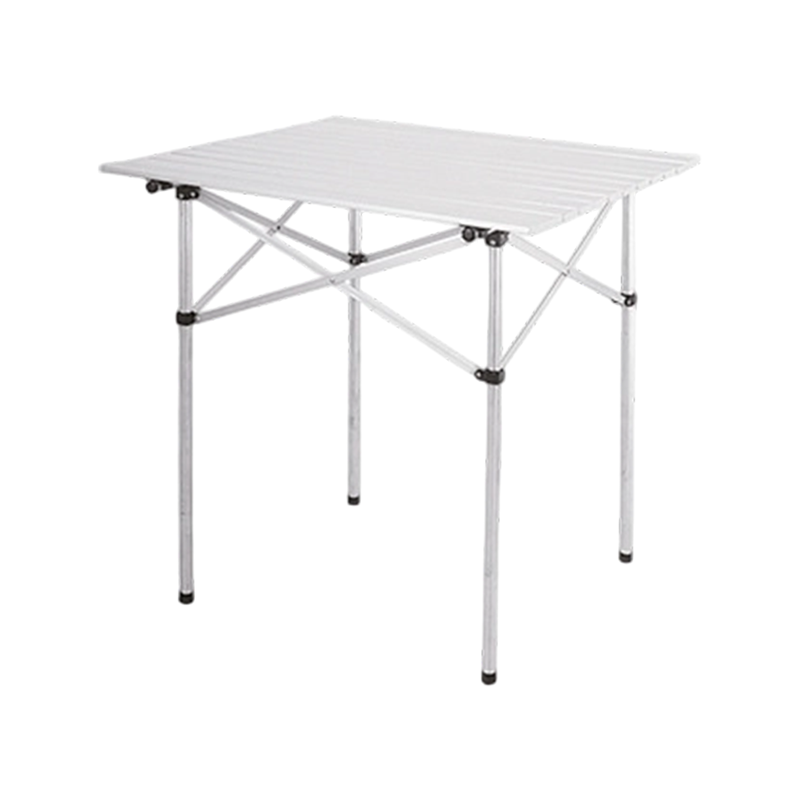
Outdoor aluminum alloy folding table, camping table, egg roll table
3. Why Aluminum Alloy Is Suitable for Portable Outdoor Furniture
Material selection determines much of a table’s performance. For a portable camping table, the material must be light enough for transportation, strong enough to support concentrated loads, resistant to environmental exposure, and compatible with efficient mass production.
3.1 Low Weight and Transport Efficiency
Aluminum alloy has a lower density than steel. This allows manufacturers to create a frame with useful strength without adding excessive weight. For campers, the benefit is straightforward: a lighter table is easier to carry from a vehicle to a campsite, move around a cooking area, or pack with other equipment.
For distributors and retailers, lower product weight can also improve handling during warehousing, order fulfillment, and delivery. A compact folding table can be packed more efficiently, helping reduce the amount of space required for inventory. These advantages become increasingly important when products are shipped internationally or supplied to markets where customers expect portable equipment.
3.2 Corrosion Resistance
Outdoor furniture is regularly exposed to moisture. Rain, wet ground, condensation, spilled drinks, cooking vapors, and coastal air can accelerate corrosion in untreated steel. Aluminum alloy is naturally better suited to these environments because its surface oxide layer provides a degree of protection.
Material selection alone does not eliminate corrosion risk. Fasteners, hinges, pivot pins, surface treatments, and contact points must also be considered. A well-designed table uses compatible materials and appropriate finishes at joints so that corrosion does not begin in hidden or highly loaded areas.
3.3 Strength-to-Weight Performance
The most important advantage of aluminum alloy is not simply that it is light. It is that it can deliver a favorable strength-to-weight ratio when the tubing dimensions, wall thickness, joint design, and load paths are correctly engineered.
A well-designed frame transfers tabletop loads through the support rails, leg assemblies, hinges, and ground-contact points. The geometry of these components is as important as the alloy itself. A poorly designed aluminum table may flex excessively, while a properly designed one can remain stable under cookware, equipment, and moderate dynamic forces.
3.4 Suitability for Manufacturing
Aluminum alloy is compatible with extrusion, cutting, bending, drilling, swaging, machining, and surface finishing processes. This allows manufacturers to create repeatable profiles and optimize the frame for both performance and folded volume.
CragHaven Outdoor uses China’s mature manufacturing infrastructure to convert product concepts into repeatable components. The company’s role extends beyond factory sourcing. It participates in design refinement, sampling, testing, and production coordination, helping ensure that the final product remains consistent with the intended outdoor application.
4. Frame Geometry and Stability Under Dynamic Wind Loads
Wind resistance is an important consideration for any freestanding outdoor table. A table exposed to wind experiences horizontal drag against the tabletop and frame. Depending on the surface area, table height, ground condition, and wind direction, the resulting force may cause sliding, rocking, twisting, or overturning.
For a typical 70 by 70 centimeter tabletop, wind at approximately 40 kilometers per hour can create a dynamic pressure of about 75 pascals. This may produce a lateral force of approximately 37 newtons on the tabletop alone. At approximately 60 kilometers per hour, dynamic pressure can rise to around 170 pascals, with lateral forces exceeding 83 newtons depending on the shape and exposure of the table.
Actual outdoor wind is rarely constant. Gusts can be significantly stronger than average wind speed, especially on exposed beaches, ridgelines, open fields, and coastal campsites. The table must therefore resist short-duration peak loads rather than only steady pressure.
4.1 Leg Splay Angle
Leg splay describes the outward inclination of the legs from the vertical position. A moderate outward angle increases the distance between the ground-contact points and the centerline of the table. This creates a wider effective footprint and improves resistance to lateral movement and overturning.
A leg splay of approximately 8 to 12 degrees can provide a practical balance between stability and packability. Excessive splay may enlarge the folded structure or interfere with nearby equipment, while very small splay angles may provide insufficient resistance to side loading.
Internal development testing indicates that a 10-degree splay can increase effective footprint width by approximately 25 percent compared with vertical legs. In wind-load comparisons, this geometry produced approximately 40 to 50 percent better lateral stability than a narrow vertical-leg configuration. These values depend on the table size, leg profile, ground surface, and test method, but they demonstrate the importance of geometry.
4.2 Height-to-Width Ratio
Table height affects the overturning moment created by wind. When a horizontal force acts at a greater height above the ground, it creates a longer lever arm and a greater tendency to rotate the table about its outer leg.
A 50-centimeter table generally has a lower center of gravity and a shorter wind lever arm than a 70-centimeter table. Under comparable conditions, a lower configuration may show approximately 35 percent less tipping tendency. However, a standard dining or food-preparation height is more comfortable for many users.
Adjustable two-stage legs can provide a useful compromise. Users can select a higher position for dining and cooking or lower the table when conditions are windy. This adaptability is valuable for users who need one product to serve several outdoor scenarios.
4.3 Footprint Shape
The shape of the footprint affects both lateral force and torsional behavior. A rectangular table measuring 70 by 50 centimeters presents a smaller windward area when the 50-centimeter side faces the wind. In this orientation, the lateral force may be approximately 28 percent lower than that of a 70 by 70 centimeter square tabletop.
However, the longer dimension can increase the lever arm for certain corner impacts. This means that reducing frontal area does not automatically improve resistance to twisting. The support frame and bracing pattern must be designed to manage both direct lateral forces and off-axis torsional loads.
5. Cross-Bracing and Torsional Rigidity
Cross-bracing connects parts of the frame and prevents the legs from moving independently. It is particularly important for folding tables because the joints required for portability can otherwise introduce movement or play.
When wind strikes the table from the front, the primary concern may be lateral deflection. When wind strikes a corner, the force can create a twisting moment. If the tabletop rotates relative to the leg assembly, cookware may slide, the table may wobble, and repeated movement may loosen the joints.
5.1 H-Bracing
H-bracing uses horizontal members to connect the legs, usually at mid-height or near the upper leg assembly. It creates a more rigid rectangular support system and helps prevent the legs from spreading apart.
Compared with a table without bracing, an H-braced design may improve lateral stability by approximately 30 to 40 percent. Its advantages include moderate weight, simple construction, and relatively easy folding. Its limitation is that horizontal bracing alone may not adequately prevent diagonal deformation or twisting between the tabletop and legs.
5.2 X-Bracing
X-bracing uses diagonal members that cross between opposing legs or frame points. The resulting triangular or truss-like structure is efficient at resisting lateral movement because diagonal members convert side loads into axial tension and compression.
Internal wind testing has shown that X-braced tables can experience 65 to 75 percent less lateral deflection than unbraced tables under comparable conditions. The trade-off is additional weight and a more complex folding mechanism. A well-designed X-brace must clear the tabletop, avoid pinching points, and fold without creating an unnecessarily large package.
5.3 Perimeter Strap Bracing
Some ultralight tables use fabric or cord straps around the perimeter. These straps can limit leg splay and add very little weight. However, they rely primarily on tension and offer limited resistance to torsional movement.
In internal comparisons, strap-braced tables showed only approximately 10 to 15 percent improvement in lateral stability and could experience significant twist under strong wind. Strap bracing may be acceptable for calm-weather use, but it is less suitable for exposed mountain, coastal, or open-field conditions where gust direction changes rapidly.
5.4 Hybrid X and H-Bracing
A hybrid system combines the diagonal efficiency of X-bracing with the frame control of H-bracing. The X-braces manage lateral deformation along the main axis, while the H-brace ties the upper leg assembly together and helps distribute loads around the frame.
The WindMaster development configuration from CragHaven Outdoor uses this type of hybrid approach. Internal testing recorded an approximately 82 percent reduction in lateral deflection and torsional twist below 2 degrees under 70-kilometer-per-hour wind conditions. The configuration added approximately 12 percent more weight than a basic H-braced structure while providing a significant improvement in rigidity.
6. Comparative Structural Performance
The following table summarizes internal development results for several frame configurations. The values apply to a 70 by 70 centimeter table at 70 centimeters in height, tested at 60 kilometers per hour with three-second gusts at 80 kilometers per hour. Results can vary according to surface condition, anchoring, wind direction, product size, and loading.
| Frame configuration | Leg splay | Bracing pattern | Lateral deflection at 60 km/h | Torsional twist at 60 km/h | Weight added versus no brace | Recovery time |
|---|---|---|---|---|---|---|
| No bracing with vertical legs | 0 degrees | None | 48–55 mm | 9.2–11.5 degrees | Baseline | More than 6 seconds |
| H-brace with moderate splay | 5 degrees | Perimeter horizontal brace | 32–38 mm | 6.5–8.0 degrees | Approximately 6 percent | 4–5 seconds |
| X-brace with moderate splay | 5 degrees | Single-plane diagonal cross | 15–18 mm | 3.5–4.5 degrees | Approximately 18 percent | 2.0–2.5 seconds |
| H-brace with wider splay | 10 degrees | Perimeter and mid-height H-bracing | 12–15 mm | 3.0–3.8 degrees | Approximately 10 percent | 1.8–2.2 seconds |
| Hybrid WindMaster configuration | 12 degrees | X-brace on the long axis with upper H-brace | 7–9 mm | 1.6–2.0 degrees | Approximately 14 percent | 1.2–1.5 seconds |
| Perimeter strap with wide splay | 10 degrees | Fabric or cord tension | 42–48 mm | 8.5–10.2 degrees | Approximately 2 percent | 5–6 seconds |
The results demonstrate that stability is not determined by a single feature. Wide leg splay improves the footprint, while diagonal bracing reduces deformation. The most effective configuration combines both approaches with rigid joints and a controlled load path.
For ordinary recreational use in sheltered locations, a basic H-braced structure may provide sufficient performance. For exposed locations, a hybrid bracing system offers greater confidence. Buyers should select the configuration according to the intended environment rather than focusing only on minimum weight.
7. Wind Testing and Engineering Verification
CragHaven Outdoor uses a structured development process that combines analysis, laboratory testing, and field evaluation. This approach helps identify problems before mass production and allows design changes to be evaluated against measurable criteria.
7.1 Computational Fluid Dynamics
Computational Fluid Dynamics, commonly known as CFD, can be used to simulate airflow around the tabletop, frame, and support legs. The simulation helps identify high-pressure areas, separation zones, and regions where wind may generate uplift or concentrated force.
CFD does not replace physical testing. Instead, it helps guide prototype development by showing which areas require reinforcement or shape adjustment. According to the company’s development process, early simulation can reduce the number of physical test iterations by approximately 40 to 50 percent.
7.2 Wind Tunnel Evaluation
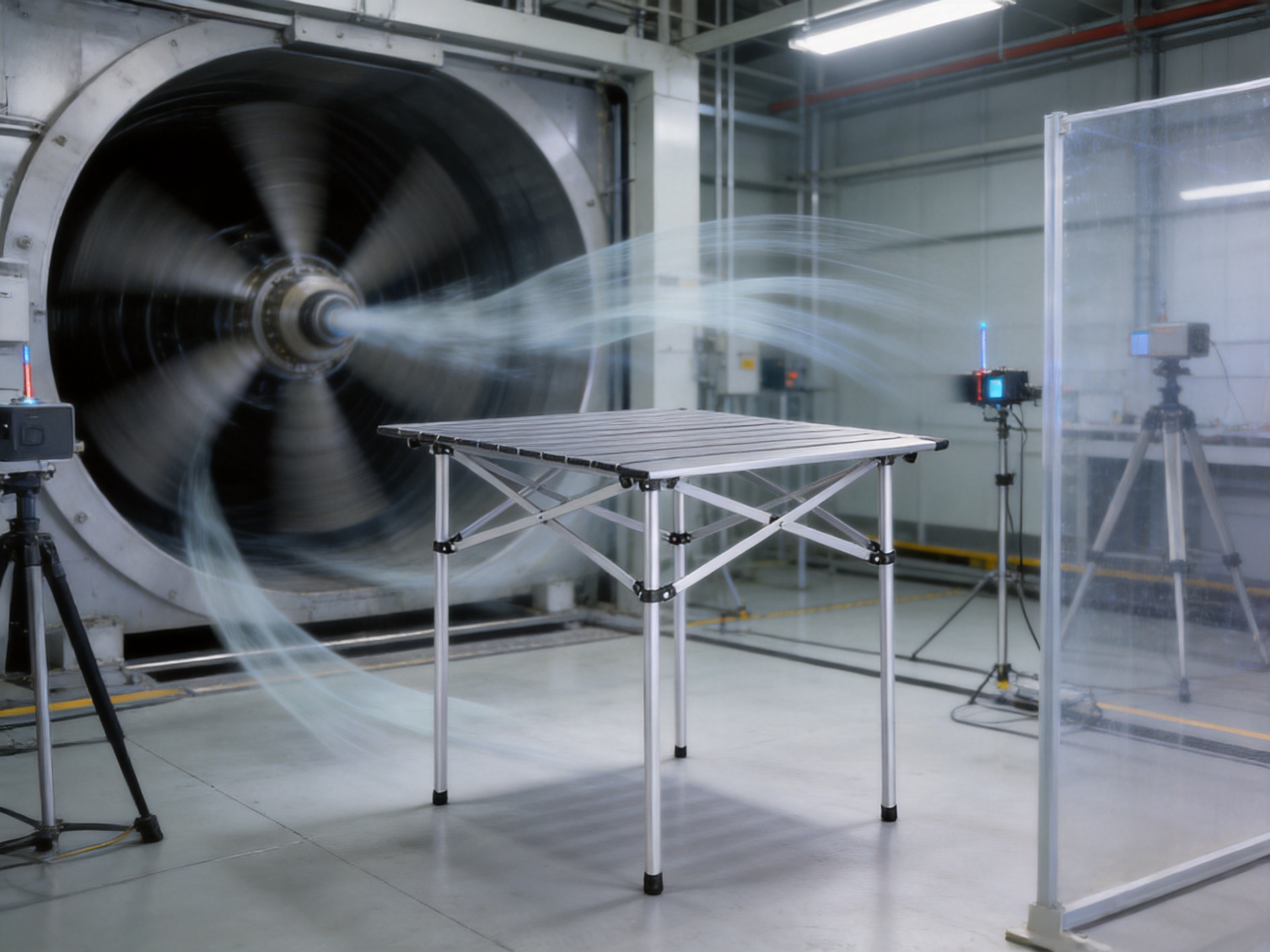
The company’s portable wind testing rig uses a test section of approximately 2.0 by 2.0 meters. Testing covers wind speeds from 20 to 80 kilometers per hour under both steady-state and gust conditions.
Laser displacement sensors measure movement at the tabletop center and other critical points. These measurements help determine whether the frame remains within acceptable limits for cooking, dining, and equipment placement.
Key evaluation parameters include lateral deflection, torsional twist, vertical uplift or sag, and recovery time after a gust. A practical target for stable dining and cooking is lateral deflection below 15 millimeters and torsional twist below 3 degrees under the defined test condition.
7.3 Field Testing
Outdoor products must also be evaluated outside the laboratory. Coastal sites expose the product to salt spray, humidity, and persistent onshore wind. Mountain sites create turbulent airflow, uneven ground, rapid weather changes, and gusts that may arrive from different directions.
CragHaven Outdoor conducts field testing at beachfront and alpine locations. Prototype tables are monitored using measurement equipment such as triaxial accelerometers and displacement sensors. Field results help confirm whether laboratory behavior corresponds to actual usage.
Testing also reveals practical issues that may not appear in a controlled environment. These can include sand entering hinges, difficulty opening the frame while wearing gloves, instability on soft soil, water accumulation, and damage caused by repeated packing and unpacking.
8. Precision Joints and Manufacturing Quality
A strong tabletop and well-designed brace are not sufficient if the joints are loose or poorly aligned. Folding furniture depends on moving connections, so joint design is one of the most important factors in long-term durability.
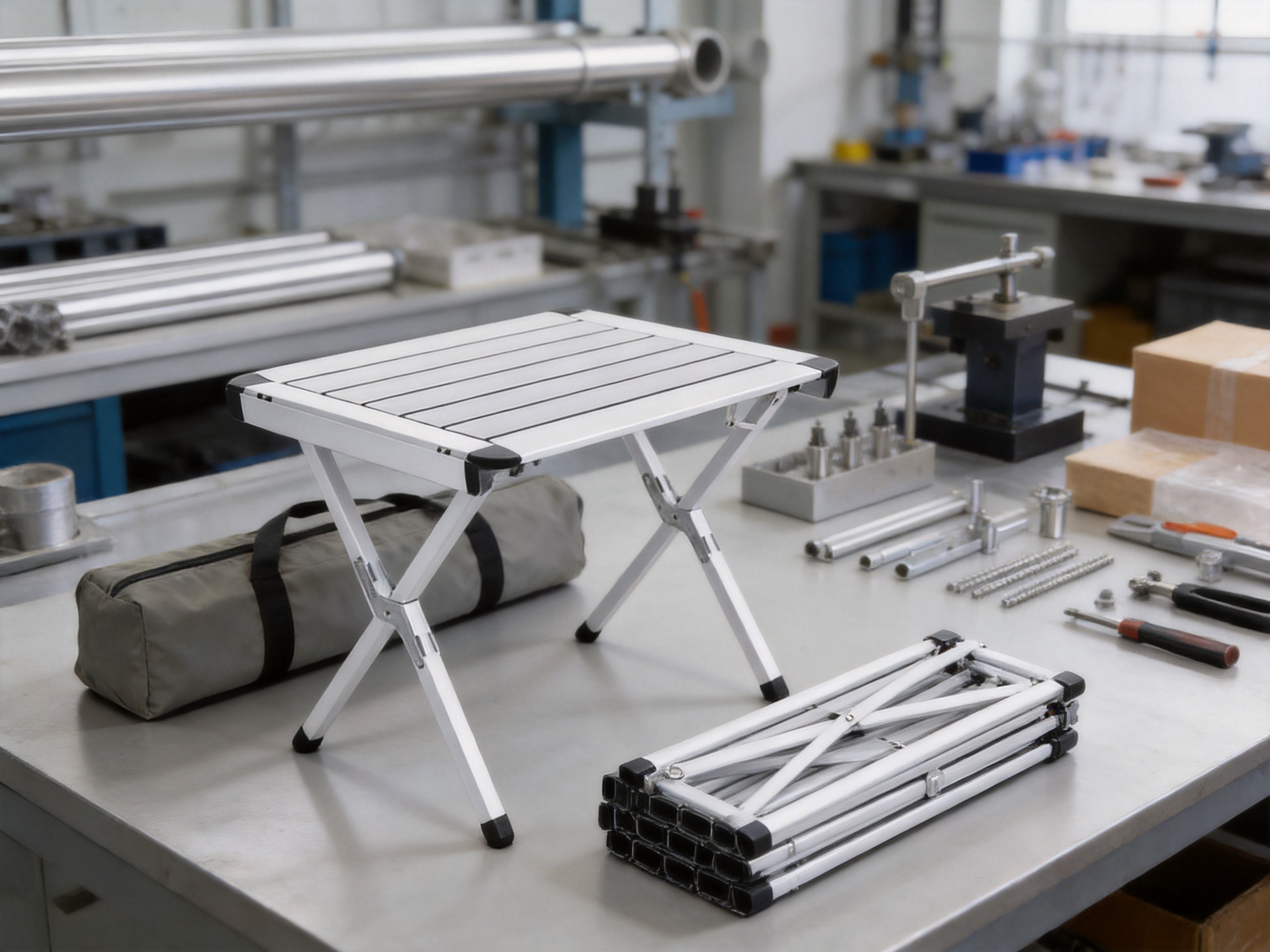
CragHaven Outdoor uses double-roll swaged tube ends and stainless steel pivot pins at key frame intersections. Swaged ends can improve the connection between tubular members, while stainless steel pivot pins provide a durable hinge interface when correctly specified and protected.
Joint articulation tolerance is controlled to approximately plus or minus 0.15 millimeters in the company’s stated process, compared with a broader tolerance of approximately plus or minus 0.5 millimeters in less controlled production. More precise joints reduce unwanted play, improve folding action, and allow bracing members to transmit loads more effectively.
Manufacturing precision also influences customer experience. A table with inconsistent holes, uneven tubing, or poorly aligned hinges may be difficult to open and close. It may also produce noise, wobble, or premature wear. Consistent tooling and inspection help ensure that the product behaves predictably from one production batch to the next.
8.1 Tube Preparation
Aluminum tubes must be cut to controlled lengths so that the frame opens squarely. Burr removal is important because sharp edges can damage fabric components, scratch surfaces, or create hazards during assembly.
8.2 Swaging and Forming
Tube ends are shaped to create reliable connections with adjacent components. Forming must be controlled carefully because excessive deformation can weaken the tube, while insufficient forming may allow movement at the joint.
8.3 Drilling and Hole Alignment
Pivot holes and fastener holes must align accurately across the folding structure. Misalignment increases friction and may cause uneven loading. Production jigs and fixtures help keep hole positions consistent.
8.4 Surface Treatment
Depending on the final specification, aluminum parts may receive anodizing, powder coating, or another protective finish. Surface treatment can improve appearance, scratch resistance, and environmental durability. The appropriate finish depends on the buyer’s target market, color requirements, and intended usage conditions.
8.5 Assembly Inspection
Completed frames should be checked for smooth opening and closing, correct locking, uniform leg contact, tabletop fit, and overall stability. Inspection should occur during production rather than only at the final packing stage.
9. Roll-Up Tabletop Design and User Convenience
The roll-up tabletop is one of the product’s defining features. Instead of requiring users to carry a large rigid panel, the tabletop can be folded or rolled into a narrower form. This improves portability and makes the table easier to store in a vehicle, tent vestibule, equipment locker, or warehouse carton.
Aluminum slats or connected sections must be designed with appropriate spacing and flexibility. Excessive gaps can collect food or small objects, while insufficient flexibility can make the tabletop difficult to pack. The connections must hold the sections together during transport without creating sharp edges or weak points.
When unfolded, the tabletop should present a sufficiently even surface for cookware, dishes, and personal equipment. The support rails beneath the tabletop must distribute loads so that individual slats do not experience excessive bending.
The tabletop should also be easy to clean. Outdoor dining and cooking can leave behind oil, soil, food particles, and moisture. Smooth aluminum surfaces can generally be wiped with a damp cloth, while detachable or accessible components make cleaning more practical.
For OEM buyers, the roll-up tabletop provides opportunities for customization. Buyers may specify dimensions, surface colors, branding methods, packaging formats, accessory combinations, and target-market instructions. The final design should preserve the core structural performance while adapting the product to different retail channels.
10. Advantages Over Lower-Cost Competitors
Price-sensitive competitors often reduce cost by using thinner tubing, minimal bracing, loose tolerances, inexpensive fasteners, or fabric support systems. These choices may produce a lower initial price, but they can also create performance limitations.
10.1 Better Stability Than Unbraced Designs
Unbraced tables may be adequate for very light use in calm weather, but they are more likely to sway when users lean against the edge or when wind strikes the tabletop. A properly braced aluminum frame reduces this movement and helps maintain a more reliable working surface.
10.2 Greater Rigidity Than Strap-Only Systems
Fabric straps are lightweight, but they do not provide the same torsional resistance as rigid diagonal braces. A rigid frame is especially valuable when the table is placed on uneven ground or exposed to wind from changing directions.
10.3 More Durable Joints
Precision-controlled joints with stainless steel pivot pins are better suited to repeated folding than poorly aligned connections. Smooth movement reduces user frustration and can extend the useful service life of the table.
10.4 More Suitable for Harsh Environments
Aluminum alloy and corrosion-conscious component selection make the product more appropriate for humid, coastal, and variable-weather conditions than untreated steel or low-grade metal structures. Users should still dry and clean the table after exposure to salt water or heavy moisture.
10.5 Better Balance Between Weight and Performance
An extremely light table may be easy to carry but unstable under practical loads. A very heavy table may be stable but inconvenient. The design target is a balanced product that provides useful structural performance without becoming difficult to transport.
11. Manufacturing and Supply-Chain Strengths
CragHaven Outdoor is based in Hangzhou, China, and works as both an outdoor brand and a cross-border manufacturing partner. The company focuses on mountaineering, hiking, and camping scenarios, with an emphasis on products that remain functional over time.
The company’s manufacturing strength comes from combining outdoor-use knowledge with China’s established production network. This includes access to aluminum processing, tooling, hardware, surface finishing, packaging, quality control, and export coordination.
Rather than treating the product as a catalog item, the development process begins with usage conditions. Designers consider weather, terrain, transport, storage, repeated setup, and the behavior of the table under load. Sampling and optimization are treated as standard stages rather than optional activities.
This approach benefits wholesale buyers and private-label customers. A buyer can discuss not only the desired appearance and target price, but also the expected wind environment, table dimensions, load requirements, packaging needs, and distribution channel. The factory can then help determine whether the specification is technically appropriate.
For international customers, supply-chain stability is also important. Consistent components, controlled tooling, clear inspection procedures, and professional communication reduce uncertainty during repeat orders. These factors help retailers maintain product consistency across seasons and markets.
11.1 OEM and Customization Support
The table can be adapted for different customer requirements. Possible customization areas include tabletop size, leg height, frame color, surface finish, carrying bag design, packaging artwork, instruction manuals, accessory sets, and branding.
Customization should be evaluated together with structural performance. For example, changing the tabletop dimensions may alter wind loading and torsional behavior. Changing the leg length may affect the center of gravity. Adding accessories may increase weight or interfere with folding. Engineering review helps prevent cosmetic changes from creating functional problems.
11.2 Sampling and Iterative Development
Prototype samples allow the manufacturer and buyer to evaluate the product before large-scale production. Samples can be checked for appearance, folding action, dimensions, weight, stability, load capacity, and packaging efficiency.
CragHaven Outdoor’s development philosophy emphasizes repeated sampling and testing. This is particularly useful for products that must balance several competing requirements, such as low weight, compact folding, strong bracing, corrosion resistance, and efficient cost.
12. Practical Use in Different Outdoor Scenarios
12.1 Family Camping
At a family campsite, the table can serve as a cooking station, dining surface, or general storage platform. The roll-up tabletop makes it easier to pack with tents, chairs, coolers, and cooking equipment.
12.2 Mountain and Hiking Basecamps
Mountaineering and hiking users value weight reduction and compact packing. The aluminum structure offers a practical support surface without the burden of a heavy fixed table. The table can be used to organize meals, equipment repairs, navigation tools, or group supplies.
12.3 Beach and Coastal Camping
Coastal environments expose furniture to sand, moisture, and salt spray. Aluminum alloy is well suited to these conditions, although users should rinse and dry the table after exposure to salt. Sand should also be removed from hinges and pivot areas before folding.
12.4 Outdoor Cooking
The rigid tabletop provides a more dependable work surface than soft fabric tables. Users can place cookware, cutting boards, fuel systems, and food containers on the table while maintaining an organized cooking area. The table should always be used according to the manufacturer’s load and heat-safety guidance.
12.5 Events and Commercial Outdoor Use
Outdoor retailers, event operators, rental companies, and activity organizers may use folding tables in temporary workstations or customer areas. In these settings, rapid setup, repeatable folding, storage efficiency, and clean appearance are important commercial advantages.
13. Operation, Care, and Safety Recommendations
Users should place the table on the most level surface available. Even a well-braced frame can become unstable if one or more legs rest on loose stones, soft soil, or a steep slope.
All locking mechanisms should be fully engaged before placing equipment on the tabletop. The legs should be checked for equal contact with the ground. If the table includes adjustable height positions, users should confirm that both sides are set to the same level.
In windy conditions, users should lower the table when possible, orient the narrower side toward the wind, and avoid placing large lightweight objects on the tabletop. Additional stabilization may be provided by approved anchor points, sandbag loops, or weights attached near the base.
Users should not rely on a folding table as a shelter anchor or climb on it. The table should not be used for cooking above its recommended wind limit. In severe weather, the safest option is to remove equipment and fold or secure the table.
After use, the tabletop and frame should be wiped clean. Salt, mud, and food residue should not be left in hinges or joint areas. The table should be fully dry before long-term storage. Periodic inspection can identify loose fasteners, damaged straps, bent components, or excessive joint movement before these issues become serious.
14. Frequently Asked Questions
Q1: Is the table suitable for strong wind?
The table is designed with stability in mind, but no portable freestanding table should be considered completely immune to severe weather. Internal testing evaluates lateral deflection, torsional twist, and recovery after gusts. The recommended performance target is less than 15 millimeters of lateral deflection and less than 3 degrees of torsional twist at 60 kilometers per hour with gust conditions. Users should lower, anchor, or remove the table when weather becomes unsafe.
Q2: What makes the aluminum alloy frame better than a steel frame?
Aluminum alloy provides lower weight, good corrosion resistance, and a useful strength-to-weight ratio. Steel may offer high strength, but it is generally heavier and requires stronger corrosion protection. For portable camping furniture, aluminum provides a practical balance between mobility and structural performance.
Q3: Does a wider leg angle always make a table more stable?
A moderate outward leg angle usually improves the footprint and resistance to tipping. However, excessive splay can make the table bulky, interfere with folding, and create awkward contact with nearby equipment. The best result comes from balancing leg angle with table height, width, bracing, and joint design.
Q4: Why is X-bracing useful?
X-bracing creates a truss-like structure that resists diagonal deformation. It is especially useful against lateral forces and twisting. Its disadvantages are additional weight, more complex folding, and the need for accurate joint alignment. A hybrid X-and-H system can provide a strong balance between rigidity and usability.
Q5: Can an existing table be modified for better wind resistance?
Some measures can help, including lowering the table, adding weight near the base, and using approved ground anchors. However, structural bracing is difficult to retrofit safely. A table’s frame geometry, joints, and folding clearances must be designed together. Improvised modifications may damage the frame or create hazards.
Q6: Is the roll-up tabletop strong enough for cooking equipment?
The tabletop is designed to provide a stable surface for typical outdoor cooking and dining equipment. Users should distribute heavy loads rather than concentrating them at one unsupported point. Hot cookware should be handled with appropriate protection, and the table should not be exposed to direct flame unless specifically approved.
Q7: How compact is the table when folded?
The roll-up tabletop and folding frame are designed to reduce storage volume compared with a rigid-panel table. Exact folded dimensions depend on the selected tabletop size, frame configuration, and packaging requirements. Buyers can confirm these dimensions during the sampling and specification stage.
Q8: Can the product be customized for private-label sales?
Yes. OEM and private-label options may include dimensions, colors, finishes, carrying bags, packaging, manuals, logos, and accessory combinations. Structural changes should be reviewed by the engineering team because they may influence stability, weight, folding volume, and load performance.
Q9: How does the manufacturer control product consistency?
Consistency is supported through controlled tube preparation, forming, drilling, joint assembly, surface treatment, sampling, inspection, and functional testing. Precision at the hinges and frame intersections is especially important because loose or misaligned joints can reduce stability and shorten service life.
Q10: What should buyers consider when selecting a supplier?
Buyers should evaluate more than unit price. Important factors include material specifications, frame geometry, bracing pattern, joint quality, corrosion protection, test procedures, customization capability, packaging, production capacity, communication, and repeat-order consistency. A supplier that understands the intended outdoor environment can help reduce product-development and quality risks.
15. Conclusion
The outdoor aluminum alloy folding table is a compact but technically meaningful piece of camping equipment. Its value comes from the way multiple design decisions work together: lightweight aluminum alloy, a roll-up tabletop, folding legs, tool-free setup, portable storage, controlled joints, and wind-conscious frame geometry.
Stability is not created by one feature alone. Leg splay widens the footprint, bracing controls movement, rigid joints transfer loads, and appropriate height reduces the overturning moment. The strongest performance comes from combining these elements with laboratory testing and field verification.
For users, the result is a practical surface for cooking, dining, and organizing outdoor equipment. For retailers and wholesale buyers, the product offers a useful combination of portability, durability, customization potential, and broad application. For OEM customers, CragHaven Outdoor provides more than production capacity. It offers design participation, sampling, testing, supply-chain coordination, and manufacturing experience focused on real outdoor conditions.
By treating weather, terrain, transport, and long-term use as central design requirements, the manufacturer can deliver a folding table that is more dependable than basic low-cost alternatives. This approach supports the broader goal of creating outdoor gear that is stable, functional, repeatable, and suitable for the demands of global markets.
References
1. CragHaven Outdoor. Internal structural testing records for folding outdoor table frame configurations.
2. CragHaven Outdoor. Product development and wind-load evaluation procedures for portable camping furniture.
3. American Society of Civil Engineers. Minimum Design Loads and Associated Criteria for Buildings and Other Structures.
4. International Organization for Standardization. General principles for mechanical testing and product evaluation.
5. Aluminum Association. Aluminum Design Manual and guidance on aluminum alloy applications.
6. Engineering reference materials on dynamic pressure, wind loading, frame stability, and torsional rigidity.
7. Field observations from coastal and mountain outdoor equipment testing programs.
Product: Outdoor aluminum alloy folding table, camping table, egg roll table


- Phone: +86-15968800379
- E-mail: [email protected]
- Address: Room 1002, Huishang Building, Gongshu District, Hangzhou City, Zhejiang Province.
Copyright © CragHaven Outdoor All Rights Reserved. Outdoor Gear Manufacturers Wholesale Mountaineering Camping Gear Suppliers
