

 English
 Deutsch
 Español
 Français
Camping Stool vs Camping Chair: Comfort and Packability Compared for Campers
2026-09-21
Every outdoor trip forces a seating decision before the first step: a tiny stool or a full-bodied chair. A camping stool is a backless folding seat built to minimize pack volume. A camping chair adds a backrest and a wider sitting surface, trading packability for physical ease. At CragHaven Outdoor, a camping furniture manufacturer in Hangzhou, we design and produce both forms for buyers in Western markets, and the engineering trade-off is concrete.
When our production team engineers a stool, we build for the hiker who walks ten kilometers before sitting. When we engineer a chair, we build for the camper who spends ten hours at a basecamp. Those two users need different solutions, and the difference is measurable in weight, volume, and posture.
Definition: A camping stool is a portable backless seat with a folding frame and a fabric top, designed to minimize packed volume. A camping chair is a portable seat with a backrest and a larger sitting surface, designed for extended comfort.
Pack space check: stools pack to 1.2-1.8 liters and weigh 0.6-1.4 kg. Chairs pack to 7-12 liters and weigh 1.8-3.5 kg.
A Camping Stool Wins on Packability, Every Time
When packability is the priority, the camping stool wins without contest. A typical stool occupies about 3 percent of a 50-liter backpack, while a typical chair takes up a third of that same volume.
The packed length gap is even more useful on the trail. Most folding stools close to 30-42 cm, which fits inside a side pocket or against a hydration sleeve. Chairs fold to 55-90 cm and need to be strapped to the outside of a pack or carried in hand. Setup follows the same pattern: a stool snaps open in five seconds, while a chair takes around 30 seconds to unfold, attach the frame, and tension the fabric.
From a manufacturing perspective, a stool is a simpler product: two aluminum tubes, a seat fabric, and one hinge point. A chair requires more components, including leg tubes, a backrest frame, fabric sleeves, and multiple load-bearing joints. Fewer components on a stool mean fewer failure points on a long trail.
Weight saving: 1-2 kg carried all day makes a real difference on a 30 km hike.
Access: a stool stays inside the pack, never snagging on trees or rocks.
Volume: a chair needs enough empty space to justify its bulk.
Setup: fewer moving parts on a stool means fewer failure points.
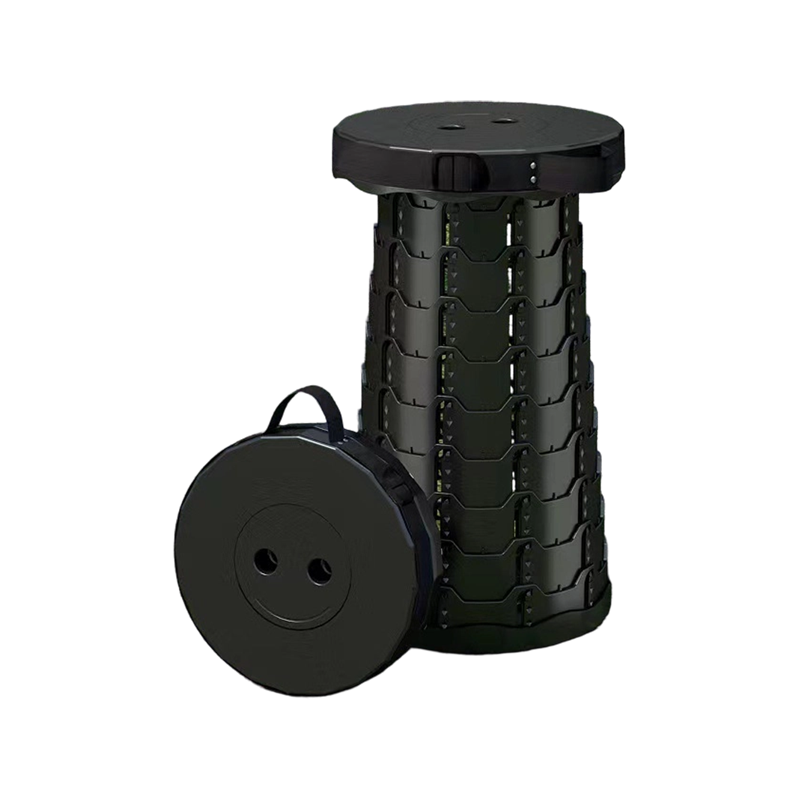
Adjustable folding hiking stool with extendable design for portable outdoor storageThis stool offers height adjustability and a compact folded size, making it a lightweight option for camping or queuing. Its thickened PP material supports load, though comfort is limited for extended sitting due to lack of backrest.View Product →
A Camping Chair Wins on Comfort, Past the 30-Minute Mark
Comfort is not about the first five minutes. It is about what happens after 30 minutes. A camping chair wins because a backrest supports the lumbar spine, and a wider seat spreads pressure across the thighs instead of concentrating it on a narrow stool top.
Seat height matters more than most buyers expect. Chairs sit at 38-48 cm, which keeps the knees at roughly a 90-degree angle. Stools sit lower at 32-42 cm, which increases load on the hips and forces a slouch. On a stool, your weight presses onto a small contact point, often a 30-40 cm square of fabric. On a chair, the frame distributes that load over a wider footprint, and the backrest carries a portion of your upper body weight.
The engineering difference is seat depth plus backrest angle. A good chair has a seat depth of 45-50 cm and a lumbar curve that matches your lower back. A stool has zero. That is why stool comfort drops sharply after 20-30 minutes, while a chair can hold you upright for hours.
When a chair is the correct tool
Camp cooking and eating at a fixed basecamp for more than one meal.
Fishing sessions, festivals, and long social nights around a fire.
Users with lower back issues who need continuous lumbar support.
Car or boat camping where pack volume is not constrained.
Portable multi-functional camping chair with aluminum frame and breathable meshThis chair provides lumbar support and a deeper seat for extended comfort, with a breathable mesh back panel and side pockets for storage. Its quick-folding design and aluminum frame balance portability and durability.View Product →
Camping Stool vs Camping Chair: Specification Comparison
The engineering gap between a stool and a chair is best understood through raw specifications. These are reference ranges our production team uses when setting OEM requirements for wholesale buyers.
Spec comparison of typical folding camping stools and camping chairs.
Attribute
Camping Stool
Camping Chair
Packed volume
1.2-1.8 L
7-12 L
Weight
0.6-1.4 kg
1.8-3.5 kg
Seat height
32-42 cm
38-48 cm
Backrest
None
Yes
Setup time
5 sec
30 sec
Max load
100-150 kg
120-150 kg
Best scenario
Day hikes and treks
Basecamp and car camping
The single clearest difference is pack volume: a chair takes five to eight times the space of a stool. When volume is limited, the choice is already made.
Packability Data: Volume and Weight in One Chart
Packability data confirms what the spec table shows. The chart below compares packed volume using typical mid-range products, which is what most campers will find in the market.
Packed volume comparison in liters
Stool
1.5 L
Chair
9 L
Weight is the second deciding factor: the average stool saves 1.2 kg over a chair, which translates to roughly 1 percent of body weight carried all day.
Decision Framework: Two Campers, Two Seats
The right choice depends on how long you sit and how far you carry. Use the two-column framework below as a quick test.
Choose a camping stool when
You carry a 40-liter or larger backpack on long days.
Stops last 5-15 minutes for water and food.
Gear must fit inside the pack, not on the outside.
Every kilogram off your back matters.
Choose a camping chair when
You stay in one camp for a full day or longer.
Meals are long, social, and repeated.
You have lower back concerns and need real back support.
A car, boat, or pack animal carries the gear.
If you are still undecided, read our guide on choosing camping gear for different outdoor scenarios. The same selection logic applies to tents, sleeping bags, and cooking systems.
What to Check Before Buying a Stool or Chair
Four specs decide whether a portable seat meets your needs: folded length, seat height, weight capacity, and frame material. Check these in that order, especially for wholesale orders where quality must be consistent.
Folded length: below 40 cm for a stool; below 60 cm for a chair.
Seat height: 38-45 cm for a chair to keep your knees at a healthy angle.
Weight capacity: at least 30 percent above your body weight.
Frame material: aluminum alloy 7075 gives the best strength-to-weight ratio.
Fabric: ripstop nylon or oxford cloth with a PU coating for wear resistance.
1.5 LStool volume
9 LChair volume
42 cmStool seat height
48 cmChair seat height
For procurement teams, the material point matters most. The best stools and chairs use cold-forged aluminum alloy 7075, which has a yield strength around 500 MPa. Reinforced stitching at the frame junction prevents fabric tearing at the load point, and UV-resistant fabric keeps the seat from degrading after a season in the sun. Ask your supplier for those specific details. CragHaven Outdoor manufactures both stools and chairs with these specifications and supports OEM customization down to fabric color and laser-engraved logos.
Frequently Asked Questions
Is a camping stool or camping chair better for backpacking?
A camping stool is almost always better for backpacking. Its packed volume is roughly one-fifth of a chair, and the weight saving is typically 1-2 kg. Choose a chair only when your camp routine involves hours of sitting and the bulk is acceptable.
Can a camping stool be comfortable for long periods?
Not beyond 20-30 minutes. Without a backrest, your lower back loads continuously and pressure concentrates on the seat top. For longer sitting, a camping chair with a backrest is the right tool.
What is the weight capacity difference between a stool and a chair?
On our production line, both share similar ratings: 100-150 kg for stools and 120-150 kg for chairs. Frame material matters more than the seat type, so always choose a frame rated 30 percent above your body weight.
Are folding camping chairs worth the extra pack size?
Yes, when you sit for more than 30 minutes at a time. If camp routine includes cooking, eating, and socializing for hours, the backrest and wider seat genuinely improve comfort. If stops are short, the bulk is not worth it.
.camping-seat-guide{--accent:#2c4ea0;--text:#1f2937;counter-reset:section-counter;font-family:"Segoe UI",Arial,sans-serif;color:var(--text);background:#fff;line-height:1.7;padding:24px 16px;}
.camping-seat-guide .intro-lede{font-size:18px;line-height:1.8;font-weight:500;color:var(--text);padding:16px 0 8px;}
.camping-seat-guide p{font-size:16px !important;margin-bottom:12px;color:var(--text);line-height:1.9;}
.camping-seat-guide h2{font-size:22px;font-weight:bold;text-align:left;margin-bottom:12px !important;color:var(--text);line-height:1.6;margin-top:50px;padding-left:18px;border-left:5px solid var(--accent);}
.camping-seat-guide h2::before{counter-increment:section-counter;content:counter(section-counter,decimal-leading-zero);font-size:12px;font-weight:bold;color:#fff;background:var(--accent);display:inline-block;padding:3px 9px;margin-right:10px;border-radius:3px;vertical-align:middle;letter-spacing:0.5px;}
.camping-seat-guide h3{font-size:16px;font-weight:bold;text-align:left;margin-bottom:12px;color:var(--accent);line-height:1.9;}
.camping-seat-guide ol{margin-bottom:12px;list-style-type:decimal;list-style-position:inside;padding-left:0;}
.camping-seat-guide ul{margin-bottom:12px;list-style-type:disc;list-style-position:inside;}
.camping-seat-guide li{list-style:inherit;font-size:16px;margin-bottom:6px;color:var(--text);line-height:1.9;}
.camping-seat-guide th{font-weight:bold;border:1px solid #cccccc;padding:8px;}
.camping-seat-guide td{border:1px solid #cccccc;padding:8px;}
.camping-seat-guide caption{caption-side:bottom;font-size:16px;margin-bottom:12px;font-style:italic;color:#808080;}
.article-section table{display:table!important;}
.article-section thead{display:table-header-group!important;}
.article-section tbody{display:table-row-group!important;}
.article-section tr{display:table-row!important;}
.article-section th{display:table-cell!important;}
.article-section td{display:table-cell!important;}
.camping-seat-guide table{width:100%;border-collapse:collapse;margin:16px 0 24px;}
.camping-seat-guide table td{font-size:16px;line-height:1.9;color:var(--text);}
.camping-seat-guide table tr:first-child td{font-weight:bold;background:var(--accent);color:#fff;text-align:left;}
.camping-seat-guide table td:first-child{font-weight:bold;background:color-mix(in srgb,var(--accent) 8%,#fff);}
.camping-seat-guide table tr:nth-child(even) td{background:color-mix(in srgb,var(--accent) 3%,#fff);}
.camping-seat-guide table tr:nth-child(even) td:first-child{background:color-mix(in srgb,var(--accent) 10%,#fff);}
.camping-seat-guide table tr:first-child td:nth-child(2),.camping-seat-guide table tr:first-child td:nth-child(3){text-align:center;}
.camping-seat-guide a{color:var(--accent);text-decoration:underline;}
.camping-seat-guide a:hover{color:color-mix(in srgb,var(--accent) 70%,#000);}
.camping-seat-guide .definition-block{background:color-mix(in srgb,var(--accent) 8%,#fff);border-left:6px solid var(--accent);padding:18px;margin:16px 0;border-radius:0 8px 8px 0;font-size:16px;line-height:1.9;color:var(--text);}
.camping-seat-guide .definition-block strong{color:var(--accent);}
.camping-seat-guide .highlight-bar{background:var(--accent);color:#fff;padding:16px 20px;border-radius:8px;margin:20px 0;font-size:16px;font-weight:bold;line-height:1.8;}
.camping-seat-guide .insight-card{background:#fff;border:1px solid #e2e8f0;border-top:5px solid var(--accent);border-radius:8px;box-shadow:0 3px 12px rgba(0,0,0,0.06);padding:18px;margin:20px 0;font-size:16px;line-height:1.9;color:var(--text);}
.camping-seat-guide .data-cards{display:flex;flex-wrap:wrap;gap:12px;margin:20px 0;}
.camping-seat-guide .data-card{flex:1 1 140px;background:color-mix(in srgb,var(--accent) 4%,#fff);border:1px solid #e2e8f0;border-bottom:4px solid var(--accent);border-radius:8px;padding:16px;text-align:center;box-shadow:0 2px 6px rgba(0,0,0,0.04);}
.camping-seat-guide .data-card b{display:block;font-size:24px;color:var(--accent);font-weight:bold;line-height:1.4;font-variant-numeric:tabular-nums;}
.camping-seat-guide .data-card span{font-size:12px;color:#64748b;text-transform:uppercase;letter-spacing:0.5px;line-height:1.4;}
.camping-seat-guide .choice-grid{display:grid;grid-template-columns:1fr 1fr;gap:16px;margin:20px 0;}
.camping-seat-guide .choice-col{background:#f8fafc;border:1px solid #e2e8f0;border-radius:10px;padding:20px 18px;}
.camping-seat-guide .choice-col.stool-col{border-top:5px solid var(--accent);}
.camping-seat-guide .choice-col.chair-col{border-top:5px solid color-mix(in srgb,var(--accent) 50%,#fff);}
.camping-seat-guide .choice-col h3{font-size:16px;color:var(--accent);margin-bottom:10px;}
.camping-seat-guide .choice-col ul{margin-bottom:0;}
.camping-seat-guide .chart-block{width:560px;margin:24px auto;background:color-mix(in srgb,var(--accent) 4%,#fff);border:1px solid #e2e8f0;border-radius:12px;padding:24px;box-shadow:0 4px 16px rgba(0,0,0,0.06);}
.camping-seat-guide .chart-title{font-size:16px;font-weight:bold;text-align:center;color:var(--text);margin-bottom:18px;}
.camping-seat-guide .chart-row{display:flex;align-items:center;gap:10px;margin-bottom:14px;}
.camping-seat-guide .chart-name{flex:0 0 50px;font-size:14px;font-weight:bold;color:var(--text);text-align:right;}
.camping-seat-guide .chart-track{flex:1 1 auto;height:22px;background:#e2e8f0;border-radius:11px;overflow:hidden;}
.camping-seat-guide .chart-fill{height:100%;border-radius:11px;}
.camping-seat-guide .stool-fill{width:16.6%;background:var(--accent);}
.camping-seat-guide .chair-fill{width:100%;background:color-mix(in srgb,var(--accent) 55%,#fff);}
.camping-seat-guide .chart-num{flex:0 0 45px;font-size:14px;font-weight:bold;color:var(--text);font-variant-numeric:tabular-nums;}
.camping-seat-guide a[data-product-card=true]{display:inline-block;background:var(--accent);color:#fff;padding:12px 22px;border-radius:6px;font-weight:bold;font-size:16px;margin:14px 0 6px;text-decoration:none;line-height:1.8;transition:background 0.2s,transform 0.2s;box-shadow:0 2px 8px rgba(0,0,0,0.12);}
.camping-seat-guide a[data-product-card=true]:hover{background:color-mix(in srgb,var(--accent) 80%,#000);transform:translateY(-1px);}
.camping-seat-guide .faq-section h3{background:color-mix(in srgb,var(--accent) 6%,#fff);border-left:4px solid var(--accent);padding:8px 12px;border-radius:0 6px 6px 0;}
.camping-seat-guide .faq-section p{margin-left:12px;}
@media (max-width:768px){
.camping-seat-guide{padding:16px 10px;}
.camping-seat-guide .choice-grid{grid-template-columns:1fr;}
.camping-seat-guide .chart-block{width:100%;padding:16px;}
.camping-seat-guide .data-card{flex:1 1 100%;}
.camping-seat-guide h2{margin-top:40px;}
}
.product-card{display:block;margin:20px 0;border:1px solid #e5e7eb;border-radius:10px;overflow:hidden;font-style:normal;background:#fff}
.pc-inner{display:flex;text-decoration:none;color:inherit;align-items:center;min-height:120px}
.pc-img{width:160px;min-width:160px;aspect-ratio:4/3;height:auto;min-height:120px;object-fit:cover;flex-shrink:0;display:block;align-self:stretch}
.pc-body{padding:12px 16px;flex:1;min-width:0;display:flex;flex-direction:column;align-self:stretch;justify-content:center}
.pc-title{display:block;font-size:15px;font-weight:600;color:#111;margin:0 0 6px;line-height:1.4}
.pc-desc{display:-webkit-box;font-size:13px;color:#6b7280;margin:0 0 8px;line-height:1.5;overflow:hidden;-webkit-line-clamp:2;line-clamp:2;-webkit-box-orient:vertical}
.pc-cta{display:block;font-size:13px;font-weight:600;color:inherit;margin-top:auto}
.pc-inner:hover .pc-title{text-decoration:underline}
.article-section a:not(.pc-inner),article a:not(.pc-inner){color:inherit}.pc-cta{color:inherit!important}
View Article