

 English
 Deutsch
 Español
 Français

Engineering a More Stable Aluminum Folding Camping Table for Real Outdoor Conditions
Content
- 1 Why a Folding Camping Table Requires Serious Structural Design
- 2 Selected Aluminum Alloy for Outdoor Performance
- 3 Roll-Up Tabletop for Compact Storage
- 4 Frame Geometry and the Meaning of Stability
- 5 Wind Loads in Campsites and Mountain Environments
- 6 Cross-Bracing Patterns and Structural Efficiency
- 7 Testing Lateral Deflection and Torsional Rigidity
- 8 Precision Manufacturing from Prototype to Production
- 9 Quality Control for a Commercial Outdoor Equipment Program
- 10 Advantages Compared with Basic Competitor Designs
- 11 Options for OEM and Wholesale Buyers
- 12 Using the Table Safely in Outdoor Conditions
- 13 Q&A: Common Questions About the Aluminum Folding Camping Table
- 13.1 Q1: What is the main benefit of the aluminum alloy construction?
- 13.2 Q2: Is the roll-up tabletop strong enough for outdoor cooking?
- 13.3 Q3: Which bracing pattern is best for windy campsites?
- 13.4 Q4: Does a wider leg splay make every table more stable?
- 13.5 Q5: Why is torsional rigidity important if the table does not tip over?
- 13.6 Q6: Can an existing folding table be modified to improve wind resistance?
- 13.7 Q7: What wind performance limits are used for the tested designs?
- 13.8 Q8: Can the table be made in different sizes and colors?
- 13.9 Q9: What manufacturing details help reduce frame looseness?
- 13.10 Q10: Is the table suitable for beaches and mountain camps?
- 14 Manufacturing Strengths for Global Outdoor Brands
- 15 Conclusion
- 16 References
- 17 Product: Outdoor aluminum alloy folding table, camping table, egg roll table
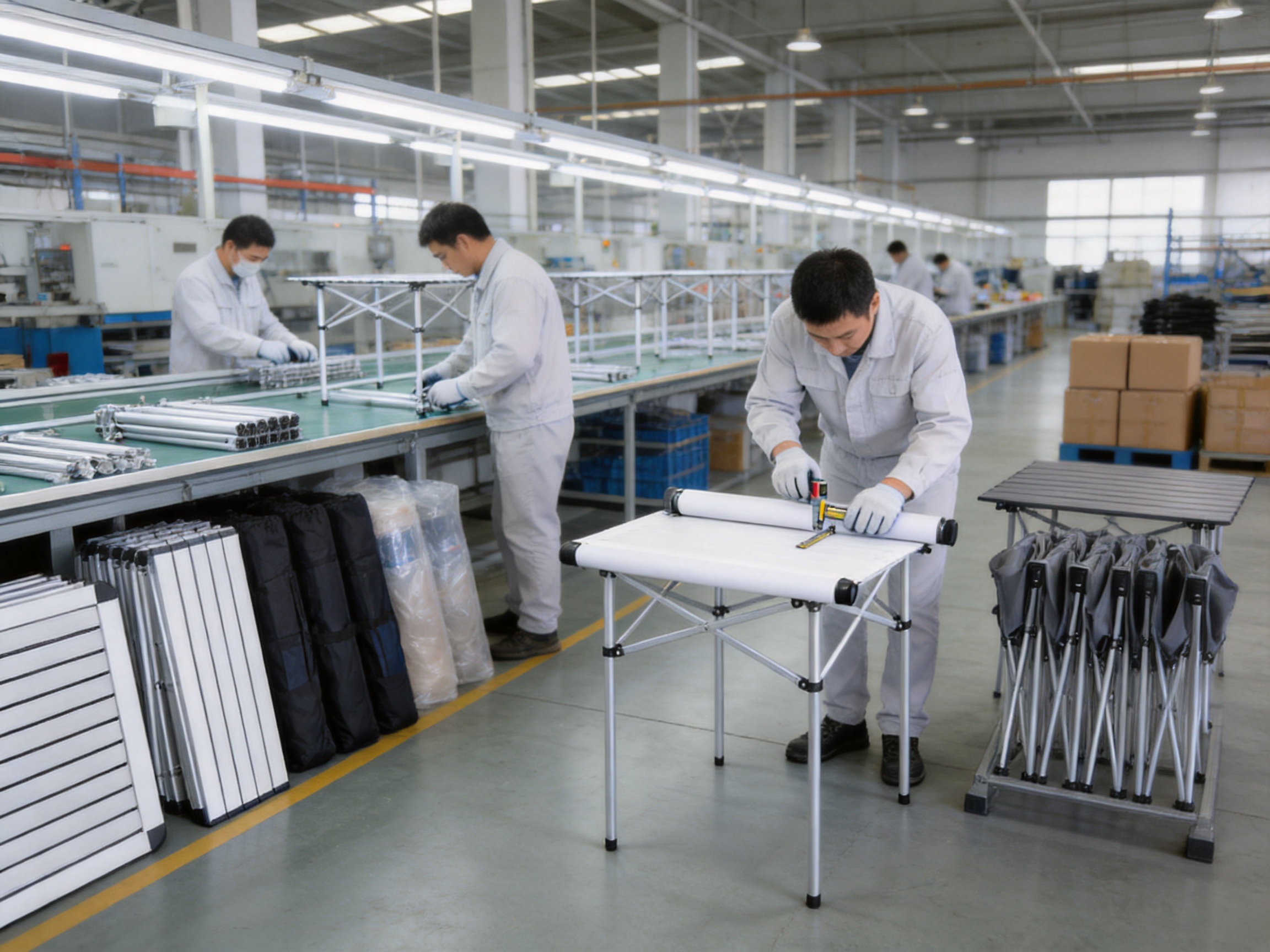
Outdoor furniture is often treated as a simple accessory, yet a camping table must perform as a structural product in changing weather, uneven terrain, transport, storage, and repeated daily use. A table used at a campsite may support cookware, fuel canisters, food containers, lanterns, coolers, and preparation tools while being exposed to wind, moisture, dust, salt spray, and accidental impacts. For this reason, the design of an aluminum folding camping table should be evaluated by more than tabletop size or folded dimensions. Frame geometry, material selection, joint construction, portability, corrosion resistance, and manufacturing consistency all determine whether a table remains dependable in real outdoor conditions.
The outdoor aluminum alloy folding table described in this article combines a lightweight roll-up tabletop with a folding structural frame. It is intended for camping, outdoor cooking, travel, picnics, basecamps, and dining in open-air environments. Its aerospace-grade aluminum alloy construction provides a useful balance between low weight and mechanical durability, while the tool-free folding mechanism simplifies setup. A dedicated storage bag allows the complete table to be carried, transported, and stored with less inconvenience than rigid outdoor furniture.
More importantly, the product can be developed as part of a broader engineering program rather than as a generic catalog item. The manufacturer’s approach begins with actual usage scenarios, including coastal campsites, mountain ridges, uneven ground, changing weather, and long-term repeated handling. Prototypes are sampled, tested, adjusted, and prepared for scalable production. This process gives buyers access to a folding table that is not only practical for consumers but also suitable for private-label, OEM, and wholesale outdoor equipment programs.
Why a Folding Camping Table Requires Serious Structural Design
A table used indoors benefits from a controlled environment, level flooring, and relatively predictable loading. Outdoor tables face a much wider range of conditions. The ground may be soft, sloped, rocky, or irregular. The user may place weight near one edge instead of at the center. A sudden gust can apply a horizontal force to the tabletop, while an angled gust can twist the frame. During transport, the table may be dropped into a vehicle, exposed to rain, or repeatedly opened and closed.
These factors create several separate performance requirements. The tabletop must provide a stable working surface. The frame must support vertical weight without excessive sag. The legs must resist outward movement. The joints must remain tight enough to limit unwanted play while still allowing folding. The complete table must be light enough to carry but sufficiently rigid to resist movement. Finally, the surface and structural components must withstand outdoor moisture and corrosion.
Many low-cost folding tables focus primarily on reducing material usage and manufacturing cost. Such products may use nearly vertical legs, thin hardware, simple perimeter straps, or joints with excessive clearance. These choices can make the table lighter at the point of purchase, but they may also increase movement and reduce service life. A table that rocks under light loading or twists during a gust can be inconvenient for dining and unsafe for cooking.
The product discussed here is designed around a more balanced objective: low transport weight, quick setup, structural stability, and long-term outdoor usability. The roll-up tabletop supports compact storage, while the aluminum frame provides a rigid foundation. The design can also be configured with different bracing arrangements, leg geometries, surface treatments, dimensions, and accessories according to the requirements of a specific market or retail program.
Selected Aluminum Alloy for Outdoor Performance
Aluminum alloy is widely used in camping equipment because it offers a favorable strength-to-weight ratio. Compared with many steel constructions, an aluminum frame can reduce carrying weight and make the product easier to handle during travel. Compared with some plastics, aluminum provides greater structural rigidity, better resistance to heat from normal outdoor cooking activities, and more predictable performance across a broad range of temperatures.
The folding table uses selected aerospace-grade aluminum alloy for its major structural components. The purpose of this material choice is not simply to create a premium specification. It is to provide a practical combination of low mass, corrosion resistance, durability, and manufacturability. Aluminum alloy tubing can be formed into compact folding members while maintaining sufficient stiffness for normal camping loads.
Corrosion resistance is particularly valuable in outdoor furniture. A table may be used beside a lake, at a beach, in a humid forest, or during rainy-weather travel. Salt spray and moisture can accelerate corrosion in unprotected metals, especially around joints and fasteners. Properly selected aluminum alloy, combined with suitable surface treatment and stainless steel hardware where appropriate, helps reduce this risk. Routine cleaning and drying remain important, but the basic material platform is better suited to outdoor exposure than untreated ferrous metal.
The aluminum surface can also support different appearance and branding requirements. Depending on the target market, the frame and tabletop components may be developed with natural metallic finishes, anodized colors, powder-coated finishes, printed details, or other approved treatments. These options allow buyers to create a coherent visual identity while preserving the functional character of the product.
Material selection must be accompanied by process control. Alloy quality, tube dimensions, wall thickness, forming accuracy, surface treatment, and hardware compatibility all influence final performance. A strong material specification cannot compensate for poor cutting, inaccurate bending, weak joints, or inconsistent assembly. Consequently, material evaluation and manufacturing control must be treated as one connected system.
Roll-Up Tabletop for Compact Storage
The roll-up tabletop is one of the product’s most recognizable functional features. Instead of relying on a rigid one-piece panel, the tabletop is made to unfold into a usable surface and roll or fold into a compact package. This arrangement reduces the space required in a vehicle, storage room, equipment locker, or warehouse carton.
For campers, compact storage can be as important as tabletop area. A family packing several chairs, sleeping systems, cooking supplies, and shelters may have limited room inside a vehicle. A mountaineer or overland traveler may need to fit equipment into a backpack, roof box, or narrow cargo compartment. The ability to pack the table into a portable bag increases the number of situations in which the product can be carried conveniently.
The roll-up structure also supports quick deployment. Users do not need specialized tools or a separate assembly kit. The tabletop can be unfolded onto the supporting frame, and the frame can be locked into its operating position through the designed folding mechanism. Tool-free assembly reduces setup time and lowers the likelihood that small screws, bolts, or fittings will be lost at the campsite.
A compact folding system must still preserve surface alignment. If the tabletop sections are poorly matched, the surface may develop uneven gaps, unwanted height differences, or excessive flex under concentrated loads. For this reason, the connection between the roll-up slats or panels, the supporting rails, and the frame is important. Dimensional accuracy, edge finishing, and repeated opening-and-closing tests help ensure that the tabletop remains practical over time.
The surface can be used for food preparation, outdoor dining, cooking equipment, camping organization, or general gear placement. Buyers may specify different tabletop dimensions, slat arrangements, colors, logos, edge details, and packaging configurations for different sales channels. The product can therefore serve both as a standard folding table and as a platform for customized outdoor equipment programs.
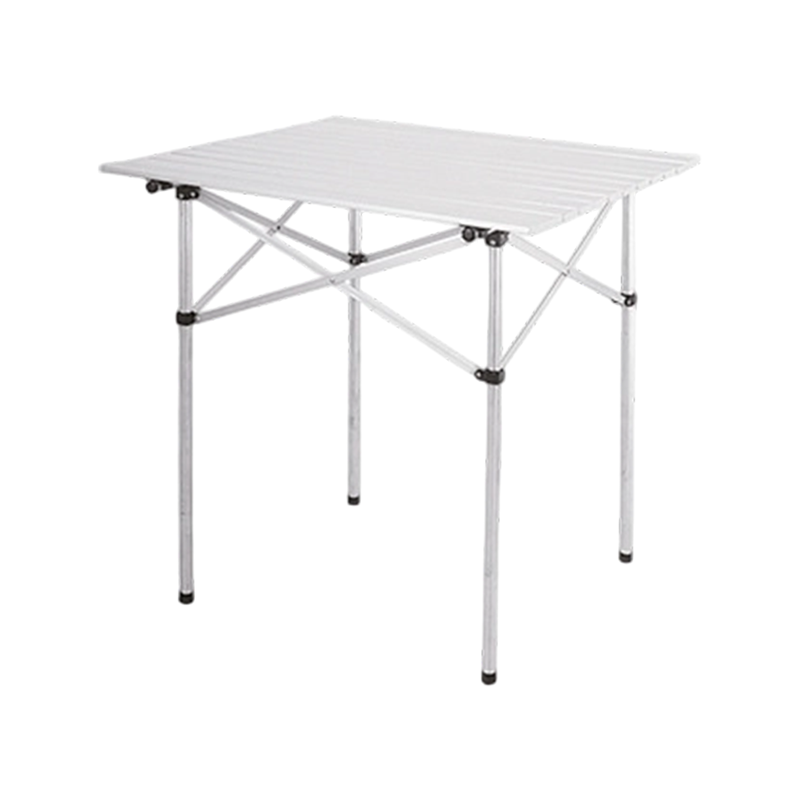
Outdoor aluminum alloy folding table, camping table, egg roll table
Frame Geometry and the Meaning of Stability
Stability is not created by a single component. It results from the relationship between the tabletop, leg spread, base footprint, brace locations, center of gravity, and ground contact points. A table with strong tubing can still perform poorly if its legs are too close together or if its joints allow excessive movement. Conversely, a carefully proportioned frame can achieve useful stability without becoming unnecessarily heavy.
One important variable is the leg splay angle, meaning the outward inclination of the legs from vertical. Legs that angle outward create a wider effective footprint at ground level. The wider base increases the distance between the center of gravity and the potential tipping edge. In the manufacturer’s testing, a leg splay of approximately 10 degrees increased effective footprint width by about 25 percent compared with vertical legs and improved lateral stability by approximately 40 to 50 percent under tested conditions.
Excessive splay can create other problems. It may increase the folded package, interfere with neighboring equipment, reduce usable space around the table, or make the table less comfortable in confined areas. The design target is therefore a balanced angle rather than the widest possible stance. A range of approximately 8 to 12 degrees is used as an engineering reference for balancing stability and packability.
Footprint shape also affects performance. Square tables provide similar resistance from different directions, which is useful when wind direction is unpredictable. Rectangular tables can reduce frontal area when the shorter side is oriented toward the wind. For example, a 70 by 50 centimeter table presents less windward surface than a 70 by 70 centimeter square table when positioned correctly. However, a longer dimension can increase the lever arm associated with corner loading and torsional forces.
Table height is another important factor. A lower table has a lower center of gravity and a shorter vertical lever arm between the tabletop and the ground. The source testing indicates that a 50-centimeter table can show approximately 35 percent less tipping tendency than a 70-centimeter table under the same wind load. Nevertheless, dining and food preparation are generally more comfortable at approximately 70 centimeters. Adjustable or two-stage leg configurations can provide a practical compromise by allowing the user to lower the table when wind conditions become difficult.
These geometric decisions distinguish an engineered outdoor table from a basic folding surface. The design is not only about how the table looks when open. It is about how the entire frame transfers load from the tabletop to the ground, how it behaves when force is applied from different directions, and how it folds without losing alignment.
Wind Loads in Campsites and Mountain Environments
Wind is one of the most underestimated risks for lightweight outdoor furniture. A table may be stable during calm weather but begin to sway, slide, or tip when a gust strikes the tabletop. The risk increases in open environments such as beaches, exposed campsites, alpine ridges, open fields, and elevated mountain bases.
Wind pressure increases rapidly with wind speed. For a typical 70 by 70 centimeter tabletop, a wind speed of approximately 40 kilometers per hour can generate a dynamic pressure near 75 pascals. Under the stated test assumptions, this can produce a lateral force of approximately 37 newtons on the tabletop alone. At approximately 60 kilometers per hour, pressure rises to around 170 pascals, and the resulting lateral force can exceed 83 newtons.
The actual force depends on tabletop shape, height, wind angle, surface openings, frame exposure, and gust behavior. A flat surface can also experience upward lift, particularly when air flows beneath or around the table. A gust does not behave like a constant force. Peak wind can be significantly higher than average wind speed, and a sudden load can produce more severe movement than a steady breeze.
The overturning moment is determined by the horizontal wind force multiplied by the height at which the force acts. A taller table therefore experiences a greater overturning moment under comparable conditions. A wide leg footprint, a lower operating height, additional ballast, and suitable anchoring points can all improve resistance to tipping.
Torsional loading occurs when wind strikes a corner or arrives at an angle. Instead of simply pushing the table sideways, the force attempts to rotate the tabletop relative to the leg assembly. If the frame has insufficient diagonal support, the table can twist even when it does not immediately tip. This movement may cause cookware to slide, create an unstable working surface, or loosen joints over repeated use.
For safety, a folding table should not be treated as a permanent structure in severe weather. Users should lower the table when possible, remove unsecured objects, add appropriate ballast, and avoid using the table for cooking during dangerous wind conditions. Nevertheless, better structural design can provide a meaningful margin of stability during the moderate and gusty conditions commonly encountered at outdoor sites.
Cross-Bracing Patterns and Structural Efficiency
Cross-bracing connects separate parts of the frame and limits unwanted movement. The arrangement of the braces determines how efficiently lateral and torsional loads are transferred. Different patterns offer different combinations of stiffness, weight, folding convenience, and manufacturing complexity.
X-Bracing
X-bracing uses diagonal members that cross between opposing legs or frame points. The resulting triangular or truss-like geometry is effective because triangles resist deformation more efficiently than unsupported rectangles. When a lateral wind force is applied, the diagonal members share the load and reduce the tendency of the legs to move independently.
In the manufacturer’s comparative tests, X-braced tables showed approximately 65 to 75 percent less lateral deflection under a 60-kilometer-per-hour wind than tables without bracing. X-bracing also improves resistance to twisting when the diagonal members are arranged across the correct structural planes. Its main disadvantages are added weight, more components, and possible interference with the folding mechanism. The design must therefore ensure that the braces can move safely during setup and storage.
H-Bracing
H-bracing uses horizontal members to connect legs at mid-height or around the perimeter. It is generally lighter and simpler than a full diagonal system. A well-positioned horizontal brace can prevent some outward leg movement and improve the table’s resistance to side loads.
H-bracing alone is less effective against torsional deformation because a rectangular frame can still distort or twist when diagonal restraint is limited. It remains useful for applications where low weight, simple folding, and economical production are priorities. The brace dimensions, attachment points, joint stiffness, and leg geometry strongly influence its final performance.
Perimeter Strap or Cord Bracing
Some ultralight tables use fabric straps, cords, or tensioned perimeter systems instead of rigid metal braces. These solutions can reduce weight and folded volume, but they primarily resist leg splay in tension. They provide little resistance to torsional movement because flexible straps cannot maintain a rigid geometric relationship between all frame members.
Testing cited in the product material showed only approximately 10 to 15 percent improvement in lateral stability for strap-braced tables, with significant twisting under a 60-kilometer-per-hour wind. Such a configuration may be appropriate for calm-weather, low-load use, but it is less suitable for exposed campsites, mountain locations, or users who require a more stable cooking surface.
Combined X and H Bracing
A hybrid system combines the strengths of diagonal and horizontal restraint. The X-braces control lateral deformation along the primary structural direction, while the H-brace helps maintain the relationship between the upper frame and the legs. In the manufacturer’s premium WindMaster configuration, this arrangement achieved an approximately 82 percent reduction in lateral deflection and limited torsional twist to less than 2 degrees under a 70-kilometer-per-hour wind test.
The hybrid system adds more weight than a basic frame, but the reported increase is approximately 12 percent compared with a basic H-braced frame. This is a favorable trade-off for users who prioritize stability, especially when the table is used for cooking or in exposed locations. The exact result depends on the final table dimensions, brace tube specifications, joint design, surface area, and test method.
| Frame configuration | Leg splay | Bracing pattern | Lateral deflection at 60 km/h | Torsional twist at 60 km/h | Weight added versus no brace | Recovery time |
|---|---|---|---|---|---|---|
| No bracing with vertical legs | 0 degrees | None | 48–55 mm | 9.2–11.5 degrees | Baseline | More than 6 seconds |
| H-brace with moderate splay | 5 degrees | Perimeter horizontal | 32–38 mm | 6.5–8.0 degrees | 6 percent | 4–5 seconds |
| X-brace with moderate splay | 5 degrees | Single-plane diagonal cross | 15–18 mm | 3.5–4.5 degrees | 18 percent | 2.0–2.5 seconds |
| H-brace with wider splay | 10 degrees | Perimeter and mid-height H | 12–15 mm | 3.0–3.8 degrees | 10 percent | 1.8–2.2 seconds |
| X and H hybrid frame | 12 degrees | X-brace on the long axis and upper H-brace | 7–9 mm | 1.6–2.0 degrees | 14 percent | 1.2–1.5 seconds |
| Perimeter strap with wide splay | 10 degrees | Fabric or cord tension | 42–48 mm | 8.5–10.2 degrees | 2 percent | 5–6 seconds |
Testing Lateral Deflection and Torsional Rigidity
Product testing gives engineering teams a way to compare design alternatives before committing to large-scale production. For folding outdoor tables, visual inspection alone cannot reliably reveal how the frame will behave under dynamic wind. Instruments and repeatable test conditions are needed to measure movement and recovery.
The manufacturer’s wind testing uses a portable wind tunnel rig with a 2.0 by 2.0 meter test section. Laser displacement sensors measure frame movement in real time. Tables are tested across wind speeds from approximately 20 to 80 kilometers per hour under both steady-state and gust conditions. Field testing at coastal and mountain locations supplements laboratory work by exposing prototypes to salt spray, turbulent air, uneven ground, and natural gust patterns.
Lateral deflection is the maximum horizontal movement of the tabletop center. For safe dining and cooking, the stated acceptable reference limit is less than 15 millimeters under the defined test conditions. A smaller deflection generally provides a more comfortable and predictable working surface.
Torsional twist is the angular rotation of the tabletop around the vertical axis. The stated acceptable reference limit is less than 3 degrees. A table may remain upright while still twisting enough to affect cookware, utensils, or user confidence. Monitoring this value is therefore important when evaluating an outdoor table for demanding use.
Vertical displacement measures uplift or sag. Wind can create upward suction, while tabletop loading can cause downward movement. Excessive vertical displacement may indicate inadequate support, flexible components, or an unstable connection between the tabletop and frame.
Recovery time measures how quickly the table returns to a low level of movement after a gust ends. A shorter recovery time indicates that the frame dissipates or redirects dynamic energy more effectively. It also means that the table spends less time oscillating after each gust, which improves user comfort and reduces the likelihood of items sliding from the surface.
Testing should be interpreted as a comparison tool rather than an unconditional guarantee for every environment. Actual performance varies with wind direction, surface friction, ground slope, ballast, tabletop loading, and setup quality. Even so, standardized testing allows buyers to distinguish between a basic lightweight table and a frame designed with measurable resistance to dynamic loads.
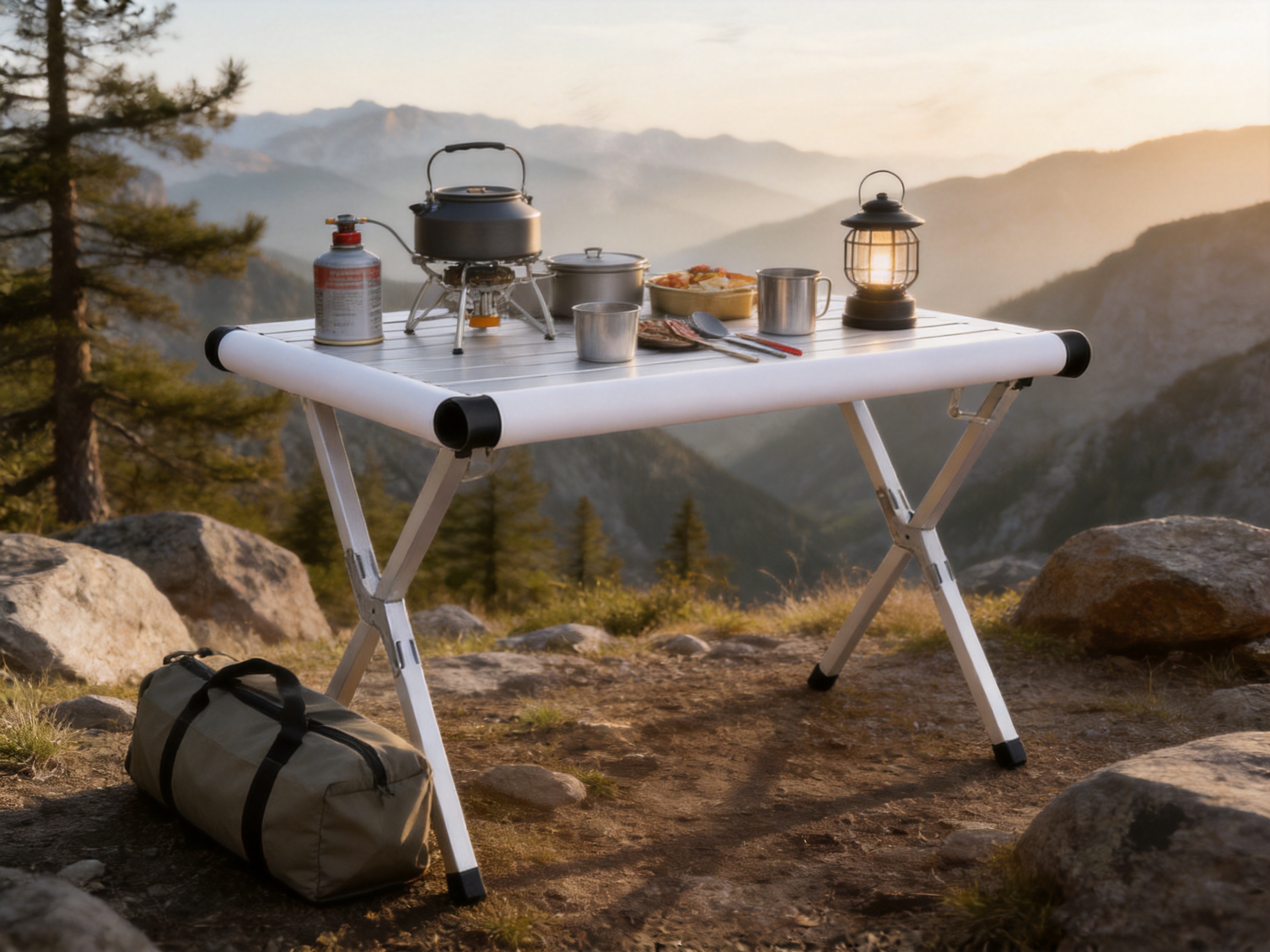
Precision Manufacturing from Prototype to Production
A successful folding table depends on manufacturing consistency as much as on the initial design. A prototype may perform well when carefully assembled, but a commercial product must reproduce that performance across many production batches. Small differences in tube length, bend angle, joint clearance, brace alignment, or fastener torque can influence stability and folding behavior.
The manufacturing process begins with product definition and scenario analysis. The design team considers how the table will be transported, how frequently it will be opened, what loads users are likely to apply, and what environmental exposure is expected. This information guides decisions about table dimensions, leg angles, brace patterns, surface finishes, packaging, and accessories.
Computer-aided design and computational fluid dynamics can be used to identify pressure zones and potential deformation before physical samples are produced. CFD modeling helps the team understand airflow over the tabletop and frame, reducing unnecessary prototype iterations. According to the supplied development information, this process can reduce the number of physical test iterations by approximately 40 to 50 percent.
Prototype sampling remains essential because outdoor furniture contains moving joints and assembled interfaces that are difficult to evaluate through simulation alone. Physical samples are opened and closed repeatedly, loaded vertically, exposed to lateral forces, and examined for joint play. Adjustments may be made to tube dimensions, brace placement, hinge geometry, locking features, and surface treatment before the product is approved for production.
Tube processing requires accurate cutting and bending. If paired legs do not match in length or angle, the table may rock on level ground. If a brace is too short, it may preload the frame incorrectly. If a brace is too long, it may fail to contribute meaningful stiffness. Consistent fixtures and process controls help maintain repeatable geometry across production units.
Joint construction is another area of emphasis. The manufacturer uses double-roll swaged tube ends and stainless steel pivot pins at frame intersections. Swaging creates a controlled connection between tube sections, while stainless steel pins provide a durable pivot interface. These details help transmit loads through the frame and reduce energy loss caused by looseness at the joints.
Joint articulation tolerance is held to approximately plus or minus 0.15 millimeters in the stated process, compared with an industry reference average of approximately plus or minus 0.5 millimeters. Tighter control can improve the balance between smooth folding and reduced movement during use. It also helps create a more consistent user experience from one unit to the next.
Surface treatment and corrosion control are considered alongside structural production. Aluminum components must be cleaned, treated, and finished according to the specified coating or anodizing system. Stainless steel hardware should be selected with attention to compatibility with aluminum and the expected outdoor environment. Inspection of edges, holes, pivots, and contact points helps reduce the risk of premature wear.
Quality Control for a Commercial Outdoor Equipment Program
For global retailers and outdoor brands, product quality involves more than the performance of a single sample. Buyers need a reliable supply chain, repeatable specifications, consistent packaging, and clear communication. A manufacturer that participates in design, engineering, sampling, and production can respond more effectively than a sourcing intermediary that only transfers a catalog image from one factory to another.
Quality control can be organized into several stages. Incoming inspection verifies alloy, tube dimensions, hardware, surface finish, and packaging materials. In-process inspection checks cutting, bending, swaging, drilling, riveting, hinge installation, and brace assembly. Final inspection confirms that the table opens and folds correctly, stands evenly, meets appearance requirements, and includes all accessories.
Functional testing should include repeated folding cycles. The table is a product with moving components, so hinge durability and locking reliability are important. A folding mechanism that works well once but becomes loose after repeated use will reduce customer satisfaction. Cycle tests can reveal wear at pivot pins, deformation at brackets, misalignment of tabletop supports, and changes in folding resistance.
Load testing can evaluate the table under centered and off-center vertical loads. Off-center loading is especially relevant because users often place a cooler, stove, or heavy container near an edge. The test team can observe tabletop sag, leg movement, brace response, and joint behavior. Dynamic loading and wind simulation add another layer of evaluation.
Packaging inspection is also important for an export product. The storage bag, carton, protective film, labels, instruction sheet, and pallet arrangement must all be suitable for long-distance handling. The table should arrive without scratched surfaces, bent components, or missing hardware. Clear setup and safety instructions help reduce incorrect assembly or misuse after delivery.
Documented inspection standards enable buyers to establish acceptance criteria for private-label programs. These criteria may include dimensional tolerances, color tolerances, logo placement, carton markings, barcode requirements, material declarations, testing records, and sample retention. Such documentation reduces uncertainty when products are shipped to different regions and distribution centers.
Advantages Compared with Basic Competitor Designs
The most important advantage of this folding aluminum table is the balance between portability and stability. Some competitors achieve a very low weight by using narrow footprints, nearly vertical legs, flexible straps, or minimal bracing. These products may be suitable for light use in calm weather, but they can move substantially when loaded or exposed to wind.
A wider leg splay and more deliberate frame geometry improve the base footprint without requiring a solid, heavy platform. The roll-up tabletop maintains compact storage while the frame provides support below. This combination is more practical for users who want to transport the table easily but do not want to sacrifice stability.
The product also offers a stronger structural option through X-bracing or a combined X and H configuration. Compared with a strap-only frame, rigid bracing provides more effective control of lateral deflection and torsional movement. This is valuable for food preparation, outdoor cooking, and use on exposed sites where a moving tabletop can create inconvenience or risk.
Another advantage is the attention given to joint precision. Low-cost tables often develop looseness because pivot holes, tube ends, and fasteners are produced with broad tolerances. Better-controlled joints reduce unwanted play and help preserve frame alignment after repeated folding. The use of stainless steel pivot pins and double-roll swaged tube ends supports a more durable connection.
Material performance provides a further distinction. Selected aluminum alloy is lightweight, corrosion-resistant, and suitable for outdoor exposure when properly finished and maintained. The material platform is compatible with different visual finishes and product configurations, allowing brands to create a consistent product family rather than selling a generic table with limited customization.
The manufacturer’s development process is also a competitive strength. CFD modeling, wind-tunnel measurement, laser displacement sensing, field deployment, and structural analysis create a more complete understanding of performance. Coastal and alpine testing is particularly useful because these environments expose products to very different types of wind: steady onshore flow near the coast and turbulent, rapidly changing gusts in mountainous areas.
Finally, OEM flexibility benefits buyers that serve different customer segments. A retailer may need a compact table for backpacking, a larger version for family camping, or a branded model with adjustable legs and anchoring accessories. Changes to dimensions, color, tabletop treatment, packaging, logos, bracing, and accessory kits can be evaluated within the same manufacturing framework.
Options for OEM and Wholesale Buyers
An outdoor gear buyer may evaluate the table according to retail price, target consumer, shipping volume, and intended usage. A basic configuration can prioritize low weight and compact packaging. A reinforced configuration can prioritize wind resistance and cooking stability. A premium model can include adjustable legs, hybrid bracing, anchor points, sandbag loops, and enhanced packaging.
Tabletop dimensions can be selected according to the market. A compact square or rectangular table may suit solo travelers and couples. A larger surface can serve family camping or group cooking. Rectangular geometry may be preferred when the table must fit beside a vehicle, inside a shelter, or along a narrow campsite area. The frame must be redesigned appropriately when dimensions change because a larger tabletop also changes wind area and lever arms.
Height options can include a fixed configuration or two-stage adjustable legs. A 50-centimeter height is useful for low seating and improved wind resistance, while a 70-centimeter height is better for conventional dining and food preparation. Buyers can choose whether both heights should be included in one product or whether separate models should be offered.
Branding can be applied to the tabletop, frame, storage bag, instruction sheet, carton, and hangtag. A coherent branding system helps the table fit into a larger range of mountaineering, hiking, and camping products. Packaging can also be adapted for wholesale distribution, e-commerce fulfillment, retail display, or mixed-container shipping.
Accessory options may include ground-stake anchor points for soft surfaces, sandbag loops for beach use, replacement hardware, protective feet, carrying straps, and reinforced storage bags. These additions should be evaluated for practical value rather than added merely to increase the feature list. Each accessory should address a known usage problem and remain compatible with the folding mechanism.
Professional buyers can also request development samples, test reports, inspection standards, and production approval samples. Clear technical communication at the beginning of a project helps prevent misunderstandings about materials, dimensions, color, tolerances, and packaging. A manufacturer that understands Western-market expectations can help translate product concepts into stable specifications suitable for retail and distribution.
Using the Table Safely in Outdoor Conditions
Even a well-engineered folding table requires correct use. Users should place it on the most level ground available and make sure all legs and locking mechanisms are fully deployed. The tabletop should be checked for secure engagement with the frame before cookware or other heavy objects are placed on it.
Heavy items should be distributed rather than concentrated at one corner. A stove, fuel container, or cooler should be positioned so that it does not create unnecessary eccentric loading. Hot cookware should be used with reasonable care, and any manufacturer guidance regarding heat exposure should be followed.
In windy conditions, lowering an adjustable table can reduce the overturning moment. Users can also remove lightweight objects that may become airborne, attach approved ballast through the designated loops, and use ground anchors where the surface allows. Ballast should be placed securely and should not create a tripping hazard.
The table should not be used as a seat, ladder, work platform, or support for loads beyond its stated capacity. Children should not climb on it, and the folding mechanism should be kept clear of fingers during setup and storage. When severe weather approaches, the safest procedure is to remove the table from exposed conditions and store it securely.
After use near salt water, mud, or dust, the table should be cleaned with fresh water or a suitable mild cleaning solution and dried before storage. Abrasive chemicals and aggressive tools may damage the surface finish. The storage bag should also be dried when necessary to prevent trapped moisture during long-term storage.
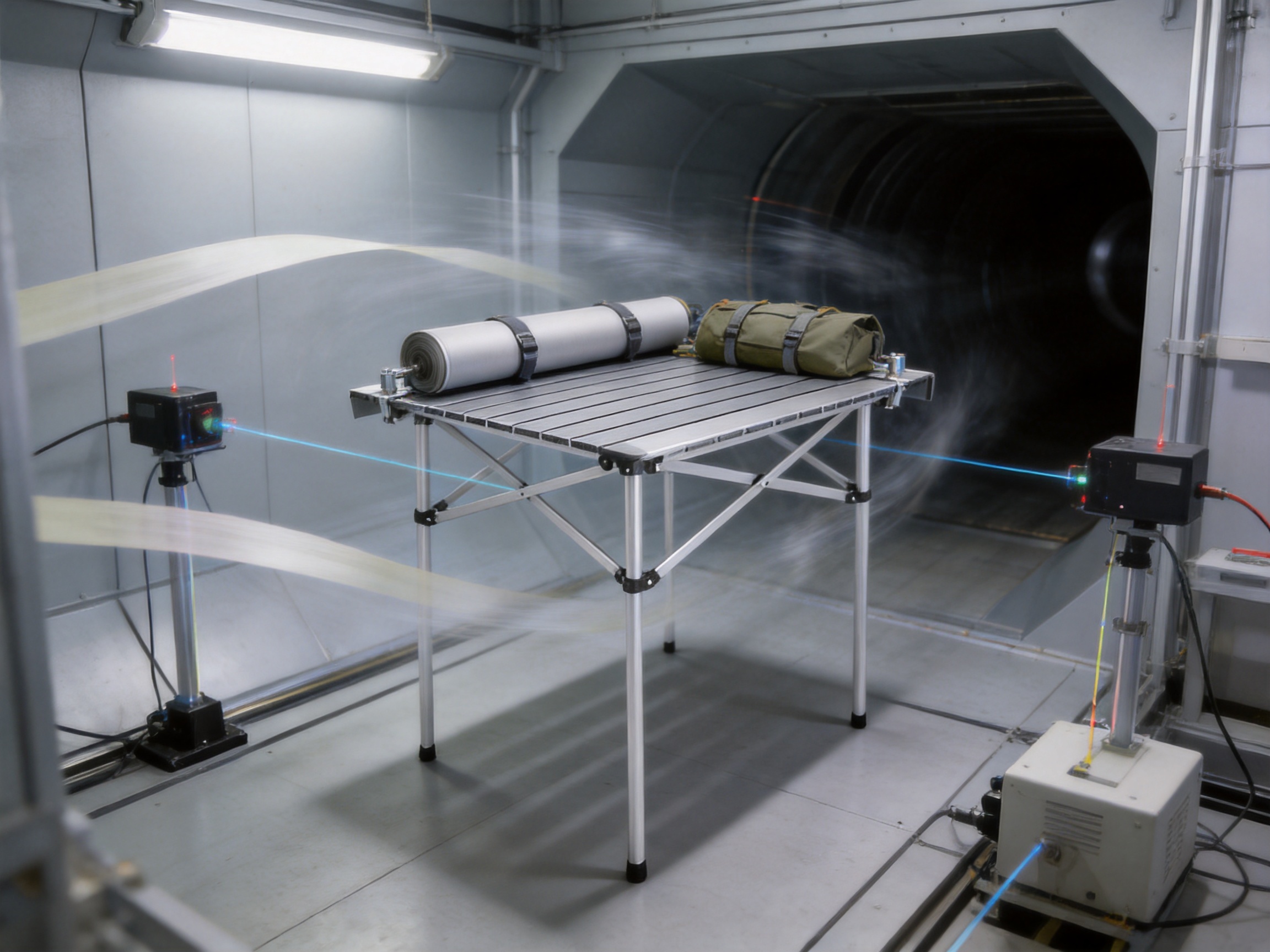
Q&A: Common Questions About the Aluminum Folding Camping Table
Q1: What is the main benefit of the aluminum alloy construction?
The main benefit is the combination of low weight, useful structural stiffness, and outdoor corrosion resistance. Aluminum alloy allows the table to remain portable while providing a stronger frame than many lightweight plastic alternatives. Proper finishing and maintenance are still necessary, especially in saltwater environments.
Q2: Is the roll-up tabletop strong enough for outdoor cooking?
The roll-up tabletop is designed for normal camping activities such as food preparation, dining, and placement of cooking equipment. Its performance depends on the specified dimensions, support arrangement, and load distribution. Users should follow the final product’s load instructions and avoid placing concentrated loads beyond the approved capacity.
Q3: Which bracing pattern is best for windy campsites?
A combined X and H bracing system generally provides the best balance of lateral stability and torsional rigidity among the configurations described in the test data. X-bracing controls diagonal deformation, while H-bracing helps maintain frame alignment. A simpler H-braced design may be adequate for ordinary use, but a hybrid frame is more suitable for exposed or demanding sites.
Q4: Does a wider leg splay make every table more stable?
A moderate outward leg angle generally increases the effective footprint and improves resistance to side loads. However, excessive splay can make the table harder to pack, less convenient in confined spaces, or more difficult to fold. The design should balance stability, portability, user clearance, and manufacturing practicality. An approximate range of 8 to 12 degrees is used as a reference in the described designs.
Q5: Why is torsional rigidity important if the table does not tip over?
A table can remain upright while twisting around its vertical axis. This movement can cause cookware or containers to slide, produce a persistent wobble, and increase stress at the joints. Torsional rigidity helps keep the tabletop aligned with the frame when wind strikes from a corner or another angled direction.
Q6: Can an existing folding table be modified to improve wind resistance?
Some simple changes can help. Lowering an adjustable table reduces the height of the center of gravity and shortens the wind overturning lever arm. Adding secure ballast to the leg area can also increase the stabilizing moment. However, major structural improvements such as retrofitting diagonal bracing may not be practical or safe unless the frame was designed to accept it.
Q7: What wind performance limits are used for the tested designs?
The stated reference targets are less than 15 millimeters of lateral deflection and less than 3 degrees of torsional twist at 60 kilometers per hour with gust conditions. The premium hybrid design recorded approximately 7 to 9 millimeters of lateral deflection and 1.6 to 2.0 degrees of twist in the comparative data. These figures are test results, not a guarantee for every terrain, loading pattern, or weather condition.
Q8: Can the table be made in different sizes and colors?
OEM and wholesale projects can be evaluated with different tabletop dimensions, frame finishes, colors, logos, storage bags, packaging, and accessory kits. Because changes in dimensions affect wind area and structural loading, larger or differently shaped versions should be reviewed through engineering sampling rather than treated as simple cosmetic changes.
Q9: What manufacturing details help reduce frame looseness?
Accurate tube processing, controlled pivot-hole dimensions, double-roll swaged tube ends, stainless steel pivot pins, and consistent assembly tolerances all contribute to reduced joint play. Repeated folding tests and final functional inspections help verify that the mechanism remains smooth while the open frame stays stable.
Q10: Is the table suitable for beaches and mountain camps?
The aluminum construction and corrosion-resistant design approach are suitable for outdoor use, including coastal and mountain environments. On beaches, users should remove salt and sand after use and use ballast or anchoring where appropriate. In mountain conditions, gusts can be turbulent and unpredictable, so the table should be lowered, weighted, or stored when wind becomes unsafe.
Manufacturing Strengths for Global Outdoor Brands
The manufacturer behind this product operates as both an outdoor brand and a cross-border manufacturing partner based in Hangzhou, China. Its focus includes mountaineering, hiking, and camping scenarios, with an emphasis on functional design, reliable materials, and long-term value. This positioning is relevant to buyers that need more than a standard factory listing and require support from concept development through production.
The company’s product philosophy begins with the environment in which equipment will be used. Weather, terrain, handling, and time are considered during development. This approach can reduce the risk of creating products that look attractive in a catalog but fail to solve real outdoor problems. For a folding table, that means examining stability, transport, setup, corrosion, cleaning, and repeated operation together.
China’s mature manufacturing ecosystem provides access to aluminum processing, hardware production, surface finishing, packaging, and related outdoor equipment capabilities. When these resources are coordinated through a controlled development process, buyers can obtain stable, replicable, and scalable production. The value lies not only in manufacturing capacity but also in the ability to convert engineering intent into repeatable units.
Long-term cooperation also benefits from professional communication. Product specifications, sampling notes, inspection standards, packaging requirements, and change approvals should be documented clearly. This reduces uncertainty for retailers and distributors that must manage product launches, inventory planning, and customer expectations across different markets.
A reliable production partner should be willing to discuss trade-offs. A stronger brace may increase weight. A larger tabletop may require a revised frame. A more complex finish may affect lead time. Adjustable legs may add components and assembly steps. Transparent discussion of these issues allows buyers to select the right configuration for their customers instead of simply adding features without understanding their effects.
Conclusion
An outdoor aluminum folding table is a compact product with substantial engineering requirements. It must be light enough to carry, compact enough to store, fast enough to deploy, and strong enough to support normal camping activities. It must also remain stable when exposed to lateral wind, corner loading, uneven ground, and repeated folding.
The described product addresses these requirements through selected aluminum alloy, a roll-up tabletop, tool-free setup, a portable storage bag, carefully considered leg geometry, and optional rigid bracing. The use of moderate leg splay improves the footprint, while X-bracing and hybrid X plus H systems provide greater resistance to lateral deflection and torsional twist than basic strap or unbraced frames.
Its strongest differentiation comes from the connection between product design and manufacturing discipline. Wind-tunnel testing, displacement measurement, CFD analysis, field testing, controlled joint tolerances, stainless steel pivot hardware, and repeated sampling create a more complete development process. These methods help transform a lightweight camping table from a simple accessory into a dependable piece of outdoor equipment.
For global outdoor brands, retailers, and wholesalers, the product also offers a flexible platform for OEM development. Dimensions, colors, finishes, branding, packaging, bracing, leg height, and accessories can be adapted to different markets. With the right specification and user guidance, the table can support camping, cooking, outdoor dining, hiking basecamps, vehicle travel, and many other applications where portability and stability must work together.
References
1. CragHaven Outdoor internal structural laboratory test data for folding table frame configurations, including lateral deflection, torsional twist, weight increase, and wind recovery time.
2. CragHaven Outdoor product development information for the outdoor aluminum alloy folding table, including material selection, folding construction, packaging, and OEM customization considerations.
3. CragHaven Outdoor dynamic wind test protocol, including steady-state wind testing, gust simulation, laser displacement measurement, and field testing at coastal and mountain sites.
4. General engineering principles for wind pressure, overturning moments, lateral stability, torsional rigidity, and braced-frame behavior in lightweight outdoor structures.
5. General manufacturing quality-control practices for aluminum tubing, swaged joints, stainless steel pivot hardware, surface finishing, folding mechanisms, and export packaging.
Product: Outdoor aluminum alloy folding table, camping table, egg roll table


- Phone: +86-15968800379
- E-mail: [email protected]
- Address: Room 1002, Huishang Building, Gongshu District, Hangzhou City, Zhejiang Province.
Copyright © CragHaven Outdoor All Rights Reserved. Outdoor Gear Manufacturers Wholesale Mountaineering Camping Gear Suppliers
